

LinkedIn Ads
- LinkedIn Ads Revenue Attribution
- LinkedIn Ads Customer Journeys
- LinkedIn Ads CRM Sync
- LinkedIn Ads Optimization
- LinkedIn Ads Benchmarks

Google Ads

Meta Ads
Cross-Channel
Ad Signals
New



19 Best B2B Marketing Attribution Software for 2026
Quick Summary
The right B2B marketing attribution software helps you see which ads correlate with revenue. In this guide, we reviewed 19 of the best tools on the market, including Fibbler, HockeyStack, and Dreamdata, plus Adobe Marketo Measure, RevSure, and Triple Whale. We looked at features, pricing, and G2 ratings, so you don't have to. You'll see how they compare and why Fibbler is the best pick for businesses that want to grow efficiently.
Here are our top three picks:
| Tool | Best For |
|---|---|
| Fibbler | Teams focused on LinkedIn, Google & Meta Ads revenue attribution |
| Dreamdata | Mid-market B2B teams needing multi-touch journey analytics |
| HockeyStack | Teams leveraging AI agents for marketing attribution & pipeline analysis |
Looking for the Best B2B Marketing Attribution Software?
With B2B buyer journeys spanning months and multiple touchpoints, businesses that rely on spreadsheet reporting or platform pixels often fly blind. This is why data-driven companies invest in attribution software to see the full picture.
The right software helps you:
- Connect ad platforms directly to your CRM.
- Track every touchpoint in the buyer journey.
- Identify which campaigns are linked to revenue.
- Optimize ad spend to maximize ROI.
- Show marketing influence to leadership.
Why Trust Us?
We built Fibbler because we saw how broken B2B attribution was for paid channels. Our platform helps companies see exactly which accounts engage with their LinkedIn, Google, and Meta Ads and how that activity connects to real pipeline in HubSpot and Salesforce.
We live and breathe attribution data every day, helping marketers move beyond vanity metrics to revenue-focused reporting. We've analyzed millions in ad spend to help users track ROI and prioritize engaged accounts rather than wasting budget on the wrong audience. This makes us uniquely qualified to evaluate the attribution software that actually delivers on its promises.
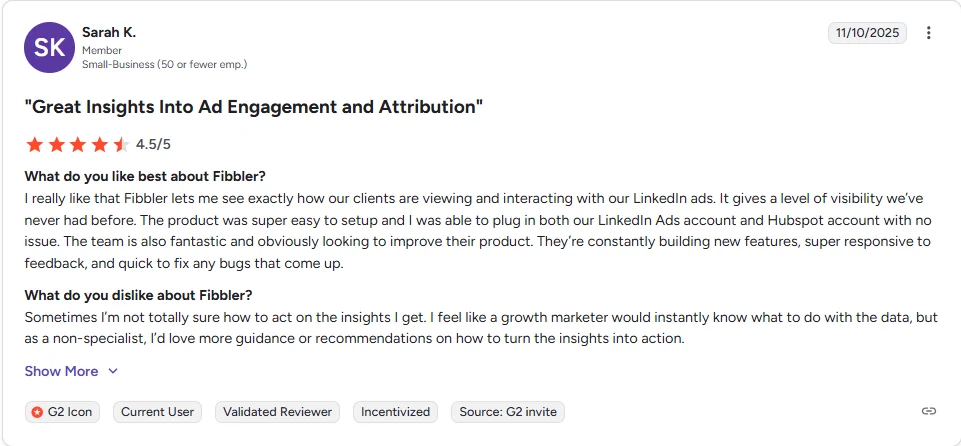
Here's a verified G2 review from one of our satisfied customers:
In short, we know exactly what it takes to turn messy ad data into clear revenue insights.
Now, onto the list!
19 Best B2B Marketing Attribution Software
| # | Tool | Key Features | Best For | G2 Rating | Pricing |
|---|---|---|---|---|---|
| 1 | Fibbler | LinkedIn, Google & Meta Ads attribution, Impression caps, CRM sync | LinkedIn, Google & Meta Ads revenue attribution | 4.9/5 | Starts at $89/mo |
| 2 | Dreamdata | Multi-touch attribution, Customer journey mapping | Mid-market B2B revenue analytics | 4.7/5 | Free & Custom |
| 3 | Factors.ai | Deanonymization, ABM intent signals, Multi-touch | Early-stage startups & ABM teams | 4.5/5 | Free & starts from $6k/year |
| 4 | Usermaven | Multi-touch attribution (7 models), ad platform & CRM sync, product analytics | Smaller B2B SaaS teams wanting attribution & product analytics in one tool | 4.8/5 | Custom |
| 5 | HockeyStack | AI agents, unified marketing & product data, lift analysis | Teams leveraging AI agents for attribution & pipeline analysis | 4.6/5 | Custom |
| 6 | Ruler Analytics | Call tracking, Offline conversion tracking, CRM sync | Industries relying on phone calls (e.g., Legal) | 4.6/5 | Starts at £269/mo |
| 7 | SegmentStream | AI-driven cookieless attribution modeling for complex digital journeys | Teams with heavy digital ad spend | 4.7/5 | Starts at $800/mo |
| 8 | CaliberMind | Deep CRM integration, data warehousing, and account-based tracking | B2B enterprises with complex sales cycles | 4.5/5 | Custom enterprise pricing |
| 9 | Heeet | Native Salesforce attribution tracking for multi-touch campaign performance | Salesforce-centric marketing and sales operations | 4.8/5 | Starts from $790/month |
| 10 | HubSpot Marketing | Native attribution reporting, Automation | All-in-one marketing teams | 4.4/5 | Free & Starts at $7/mo |
| 11 | Cometly | Server-side tracking, AI-driven attribution | Performance marketers scaling paid ads | 4.8/5 | Custom |
| 12 | Windsor.ai | Data connector for BI tools (PowerBI, Looker) | Custom reporting in BI tools | 4.6/5 | Free & Starts at $19/mo |
| 13 | Attribution | Automated multi-touch modeling | Enterprise automated modeling | 4.5/5 | Starts at $399/mo |
| 14 | InfiniGrow | AI budget allocation & forecasting | AI-driven budget forecasting | 4.7/5 | Starts at $1,500/mo |
| 15 | LeadsRx | Cross-channel attribution (Radio, TV, Digital) | Mixed media (TV/Radio + Digital) | 4.4/5 | Custom |
| 16 | DemandSense | LinkedIn ad control, audience tuning, visitor ID, revenue attribution | LinkedIn-focused ad optimization & visitor ID | 5.0/5 | Starts at $89/mo |
| 17 | Adobe Marketo Measure | Every-touch attribution, Attribution AI, online + offline channels | Enterprises already inside Adobe Experience Cloud | 4.7/5 | No public pricing |
| 18 | RevSure | GTM data graph, AI agents, pipeline forecasting, multi-touch attribution | RevOps teams wanting AI agents on top of attribution | 4.7/5 | Starts at $4,000/mo |
| 19 | Triple Whale | Triple Pixel tracking, MMM, creative analytics, Moby AI | Ecommerce and DTC brands on Shopify (not B2B CRM sales cycles) | 4.5/5 | Custom |
Let's now take a closer look at each tool.
1. Fibbler
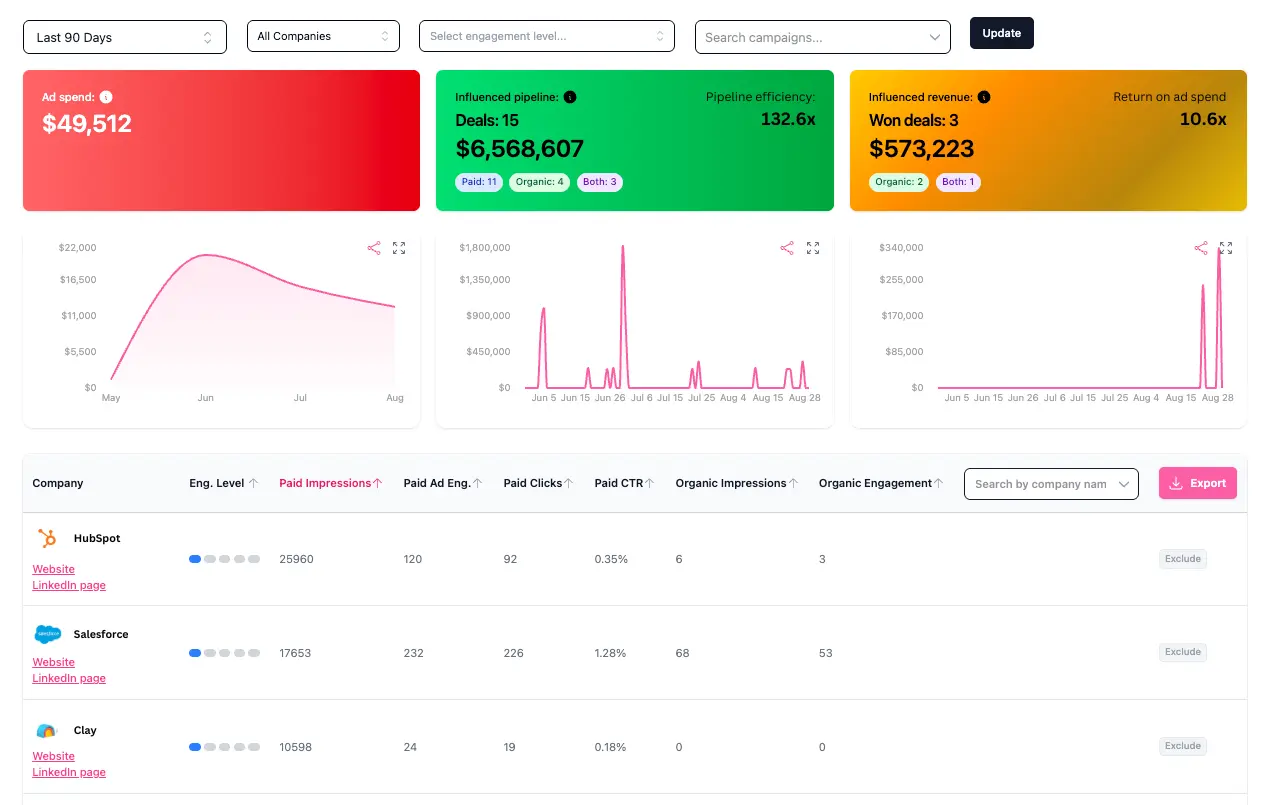
Fibbler is a B2B attribution platform and official LinkedIn Marketing Partner designed to bridge the gap between paid ad data and your CRM. It connects LinkedIn Ads, Google Ads, and Meta Ads directly with systems like HubSpot, Salesforce, Attio, and Pipedrive. It's also SOC 2 Type 1 compliant.
It helps you identify exactly which companies are clicking your ads and ties that engagement to real pipeline and revenue in your CRM. It is an ideal solution for marketers who want confidence in the ROI of paid channels and validate that their LinkedIn, Google, and Meta spend is actually reaching their ICP.
Key Features
- Multi-Channel CRM Sync: Syncs company-level engagement data from LinkedIn Ads, Google Ads, and Meta Ads directly into HubSpot, Salesforce, Attio, and Pipedrive.
- Revenue Attribution: Automatically links ad clicks and views to pipeline and closed-won revenue to indicate campaign ROI.
- Google Ads Identification: Reveals the company identity behind anonymous Google Search clicks to help you validate if your keywords are attracting the right audience.
- Meta Ads Identification: Reveals the company identity behind anonymous Facebook and Instagram ad clicks, so you can see which businesses your Meta campaigns actually reach.
- Impression Capping: Lets you set monthly limits on how often a company sees your LinkedIn ads to prevent budget waste.
- Customer Journeys: Visualizes the full path to purchase, showing every touchpoint from the first ad view to the final deal close.
Pricing
We offer three transparent, flexible plans to fit any organization:
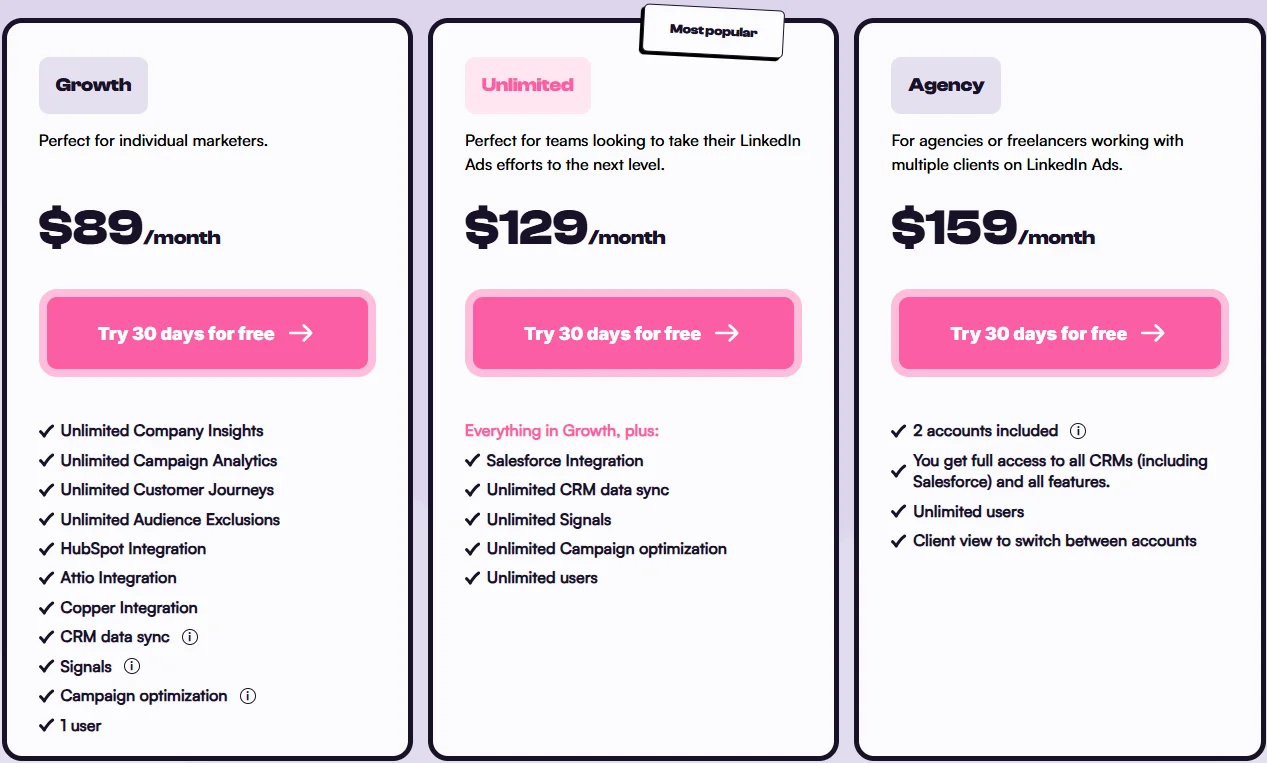
- The Growth plan costs $89/month and is perfect for individual marketers.
- The Unlimited plan costs $129/month and includes unlimited data sync and CRM integrations.
- The Agency plan costs $159/month and is designed for managing multiple client accounts.
You can also add the Google Ads Add-on and the Meta Ads Add-on for $59/month each to any plan.
We offer a 30-day free trial for the main platform and a 14-day free trial for each add-on.
Pros
- Official LinkedIn Marketing Partner status ensures reliable data access.
- Covers LinkedIn Ads, Google Ads, and Meta Ads in one CRM view.
- Fast setup connects to HubSpot and Salesforce in minutes.
- Cost controls allow for impression capping to save budget.
- More affordable than enterprise suites like Dreamdata.
- SOC 2 Type 1 compliant, audited by Sensiba in September 2026, with all customer data hosted in the EU.
Cons
- Google Ads and Meta Ads attribution are paid add-ons, not included in the base price.
- Tracks only digital paid channels, excluding offline media like TV.
Ratings
G2: 4.9/5. Users love the clarity it provides, stating it "gives a level of visibility we've never had before" and praising the seamless setup with HubSpot and LinkedIn.
What users say: Reviewers point to setup speed and the HubSpot integration, with one noting they “went live in less than 30 minutes”
2. Dreamdata
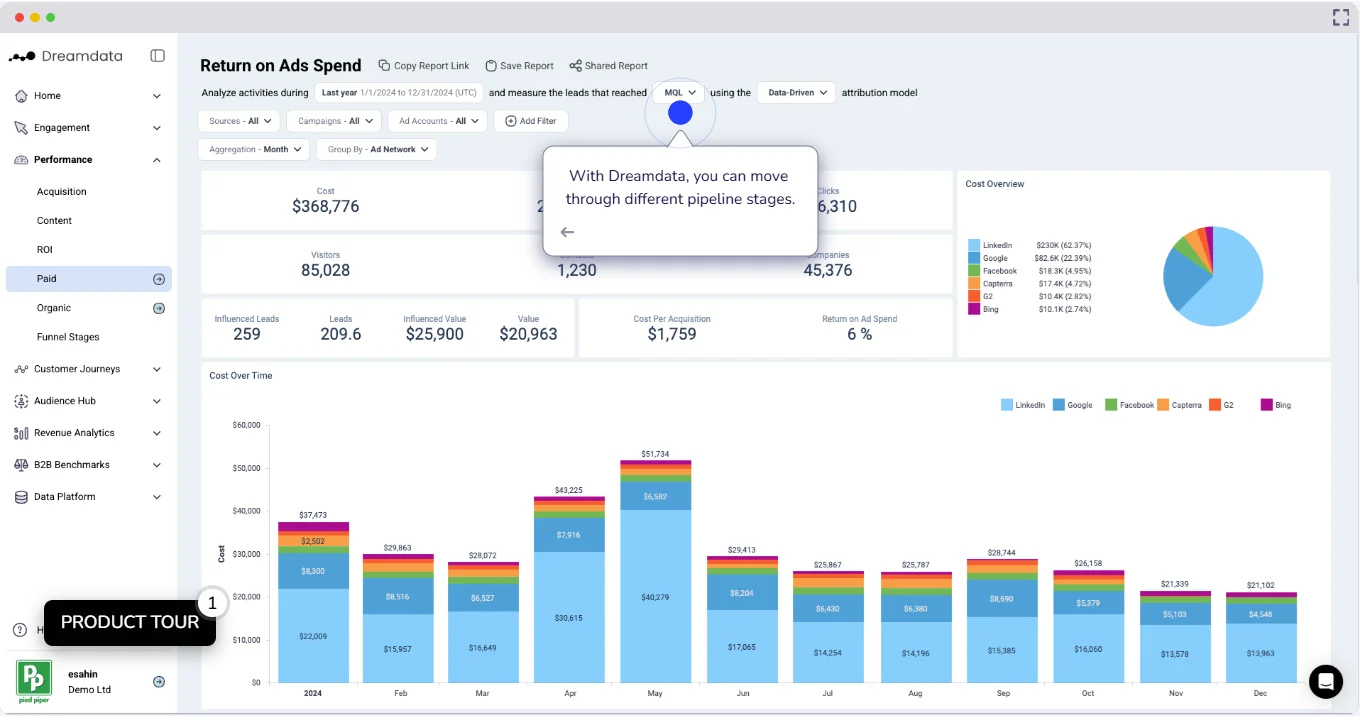
Dreamdata is a B2B revenue attribution platform. It connects data from your ad platforms, website, and CRM to build a timeline of every customer touchpoint.
It helps companies understand how different teams contribute to revenue. It is a good fit if you have a complex tech stack and need to analyze long sales cycles.
Key Features
- Journey Reporting: Visualizes the complete B2B customer journey map from the first anonymous touch to revenue.
- Revenue Analytics: Breaks down revenue by channel to show exactly what drives growth and measures real marketing impact.
- Audience Activation: Builds precise audiences using unlimited filtering and syncs them directly to major ad platforms.
- Data Warehouse Access: Sends clean, transformed data to BigQuery or Snowflake for custom analysis.
Pricing
Dreamdata offers a Free plan and a Custom paid option:
- Offers a Free plan for foundational B2B analytics and engagement scoring.
- The Advanced plan requires custom pricing for AI-based attribution, larger data volumes, and advanced controls.
Pros
- Maps the complete B2B customer journey.
- Allows teams to measure revenue impact independently.
- Free tier includes foundational analytics for smaller teams.
Cons
- The free version lacks advanced features needed by growing companies.
- Interface is complex and requires time to learn.
Ratings
G2: 4.7/5. High marks for journey transparency are balanced by frequent notes regarding the complex interface.
What users say: Reviewers single out the account journey view, calling it “easy to onboard, straightforward to use, and customizable”
3. Factors.ai
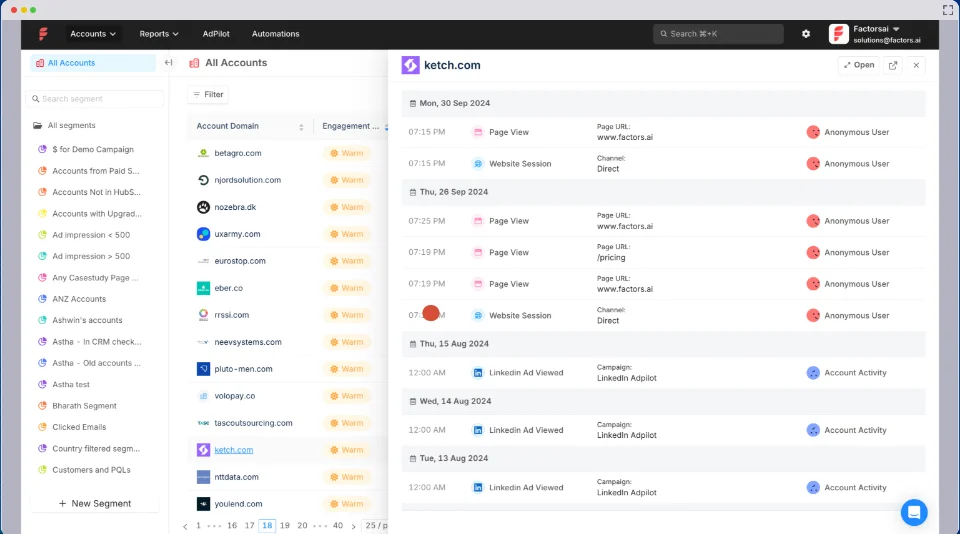
Factors.ai is a B2B platform designed to help marketing teams identify anonymous website visitors and understand which accounts are actively researching their solutions. It connects data from your website, ads, and CRM to show how different marketing channels turn into revenue.
This tool is a strong choice for early-stage startups and Account-Based Marketing (ABM) teams that need to spot high intent leads without complex manual setups.
Key Features
- Visitor Identification: Identifies a large percentage of companies visiting your website even if they do not fill out a form, giving you a clear view of account behavior.
- Lead Intelligence: Prioritizes potential customers through lead scoring and account level insights that track asset downloads and content engagement.
- Ad Automation: Features like LinkedIn AdPilot and Google AdPilot automatically update audiences based on activity to improve targeting and reduce wasted ad spend.
- Journey Analytics: Visualizes the complete path an account takes across different channels, campaigns, and pages.
Pricing
Factors.ai offers four pricing tiers:
- The Free plan allows you to identify companies visiting your site and analyze basic traffic patterns.
- The Basic plan of $6k adds CRM sync, account segmentation, and LinkedIn influence tracking for teams just getting started.
- The Growth plan of $20k per year is the most popular tier and unlocks complete buyer journey visibility, custom scoring, and advanced ABM analytics.
- The Enterprise plan of $30k per year onwards serves big budget campaigns with predictive scoring, enhanced Google Ads conversions, and third party intent data.
Pros
- Delivers real-time insights to identify high-intent accounts.
- Analytics pinpoint high-value leads accurately.
- Customer support is responsive and assists with issues.
Cons
- Initial setup is time-consuming for new users.
- Data accuracy issues occur occasionally.
- Lacks specific features found in more mature enterprise tools.
Ratings
- G2: 4.5/5.
What users say: Reviewers value the intent data, though the recurring con is a “steep learning curve”
4. Usermaven
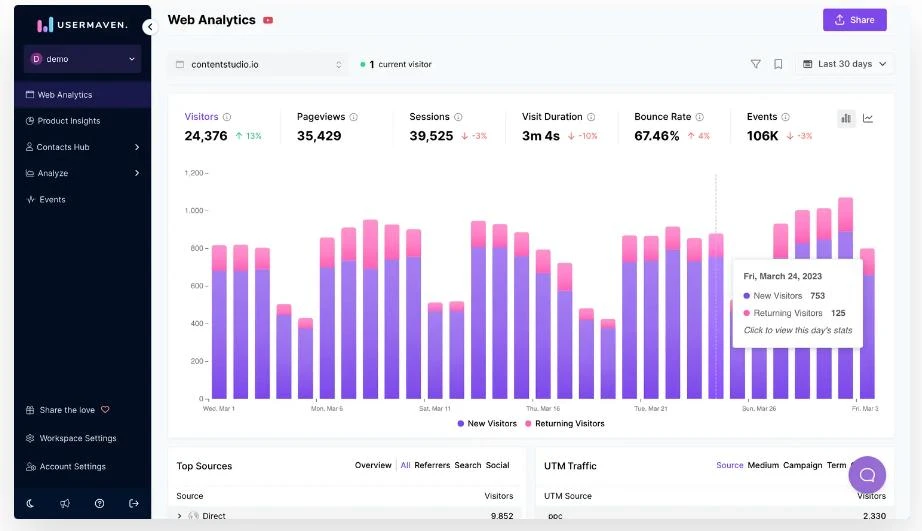
Usermaven is a marketing attribution and product analytics platform aimed at B2B SaaS teams and agencies. It connects website, ad platform and CRM data so you can see which channels and campaigns contribute to conversions, pipeline and revenue, and it also covers product analytics for what customers do after they sign up. It suits smaller teams that want attribution and analytics in one tool without a heavy setup.
Key Features
- Attribution Models: Multi-touch attribution with seven models (first touch, last touch, linear, U-shaped, time decay, plus non-direct variants) and a lookback window from 30 to 180 days.
- Paid Ads Attribution: Covers LinkedIn Ads, Google Ads and Meta Ads, with Salesforce, HubSpot and Stripe integrations for pipeline and revenue data.
- Customer Journeys: Tracks the journey with identity resolution across sessions and devices.
- Maven AI: Ask questions about your data in plain language, plus cookieless and server-side tracking included on every plan.
Pricing
Usermaven has Business and Enterprise plans, with pricing on request through a demo. Enterprise adds data warehouse export, SSO, private cloud deployment and a dedicated success manager.
Pros
- Quick to set up and easy to use, which reviewers mention more than anything else.
- Attribution and product analytics in one place.
- Privacy-friendly tracking that works without cookies.
Cons
- Pricing is not published, so you need a demo to get a quote.
- Attribution is based on tracked touchpoints from your site and CRM, so it does not capture impression-level LinkedIn view-through.
- A newer entrant to B2B attribution, so the feature set is still growing compared with the larger tools on this list.
Ratings
- G2: 4.8/5 (93 reviews)
What users say: Reviewers consistently praise the clean interface and fast setup, with G2 scoring it 9.6/10 for ease of use and ease of setup.
5. HockeyStack
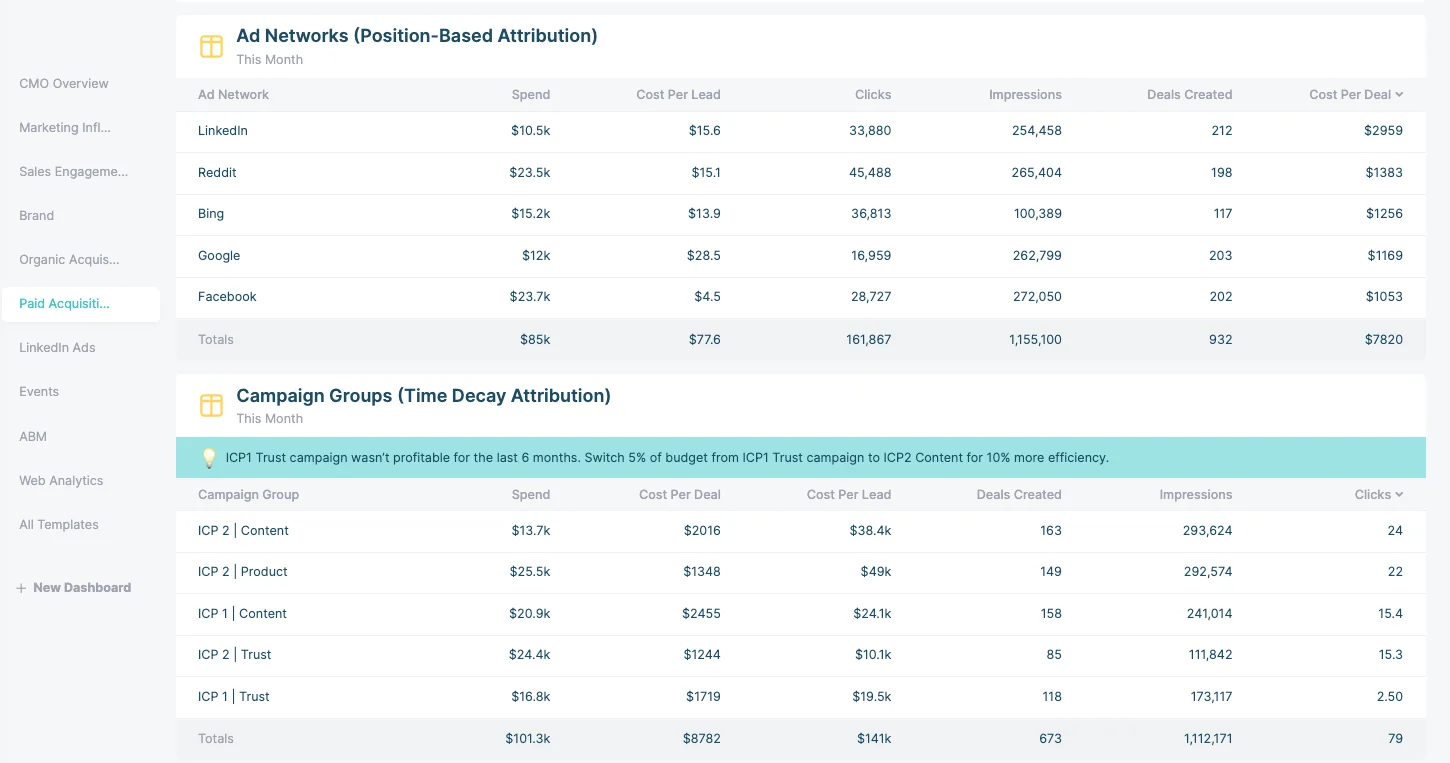
HockeyStack is an analytics platform that unifies marketing, sales, and revenue data to help B2B teams understand what drives growth. It connects your website, CRM, and ad platforms to track the entire customer journey, from the first click to a closed deal.
Key Features
- Unified Analytics: Brings together marketing, sales, and product data into one dashboard so teams can move faster and sell smarter.
- Attribution Modeling: Supports single-touch, multi-touch, and algorithmic attribution to assign credit to every touchpoint in the customer journey.
- Retroactive Reporting: Allows you to analyze past data and apply new attribution models to historical activities.
- Cross-Device Tracking: Identifies and links customer interactions across both mobile and desktop devices.
Pricing
HockeyStack’s pricing is custom. You need to fill a form to contact them
Pros
- Real-time insights track marketing performance.
- Integrates easily with existing software tools.
- Customer support resolves complex issues quickly.
Cons
- Backend management requires a technical user for correct data definition.
- Setup is time-consuming for companies with complex data.
Ratings
- G2: 4.6/5.
What users say: Reviewers praise the cookieless tracking and support, highlighting its “flexible funnel tracking”
6. Ruler Analytics
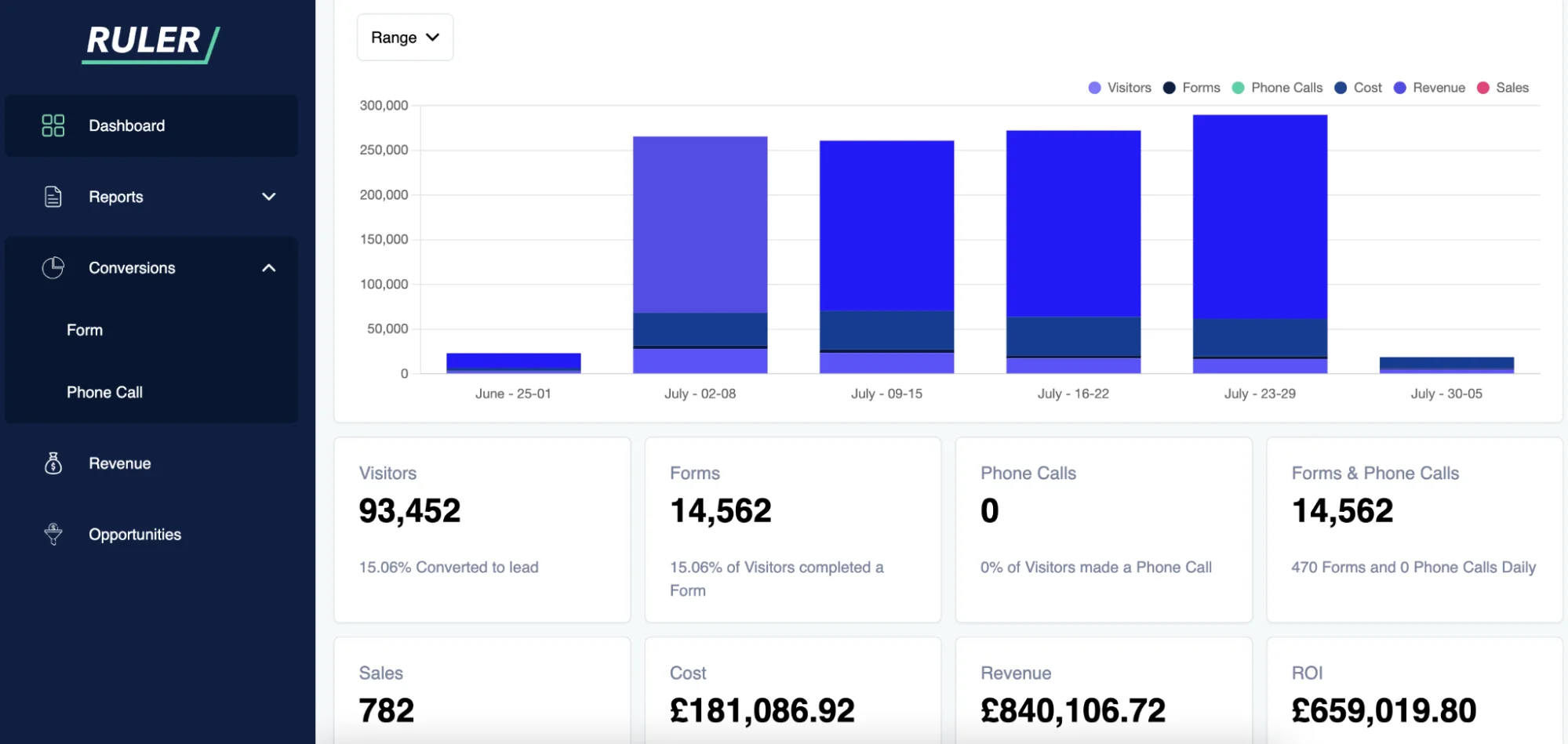
Ruler Analytics is a marketing measurement platform that connects data directly to sales revenue to track the complete customer journey. It captures phone calls and offline interactions for industries like legal and real estate where standard digital tracking is limited.
Key Features
- Call Tracking: Uses dynamic number insertion to track phone calls back to the specific marketing source that generated them.
- Offline Conversion Tracking: Allows you to measure the impact of offline touchpoints and match them to digital marketing activities.
- Revenue Attribution: Automatically attributes revenue in your CRM to the marketing channel, campaign, or keyword that drove the sale.
- Opportunity Attribution: Tracks how marketing efforts contribute to sales opportunities and pipeline growth.
Pricing
Ruler Analytics offers tiered pricing based on monthly traffic volume:
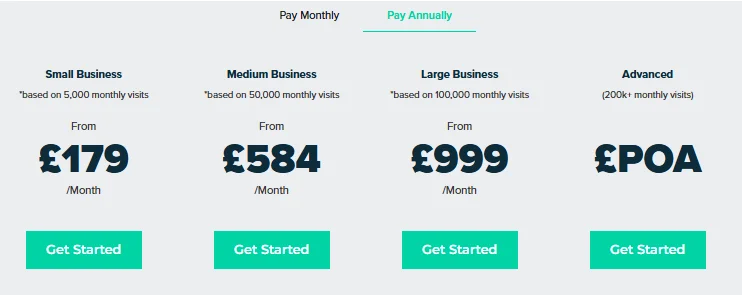
- Small starts at £269 per month for sites with up to 10,000 monthly visits.
- Medium starts at £449 per month for sites with up to 50,000 monthly visits.
- Large starts at £899 per month for sites with up to 100,000 monthly visits.
- Advanced starts at £1,349 per month for sites with 100,000+ monthly visits.
Pros
- Integrates easily with various CRM and ad systems.
- Analytics track customer journeys accurately.
- Customer support is responsive.
Cons
- Initial setup is difficult for non-technical users.
- Data management issues occur occasionally.
Ratings
- G2: 4.6/5. Users value the accurate call tracking and support but note that setup can be complex.
What users say: Reviewers rate the online-to-offline journey tracking a “game changer”
7. SegmentStream
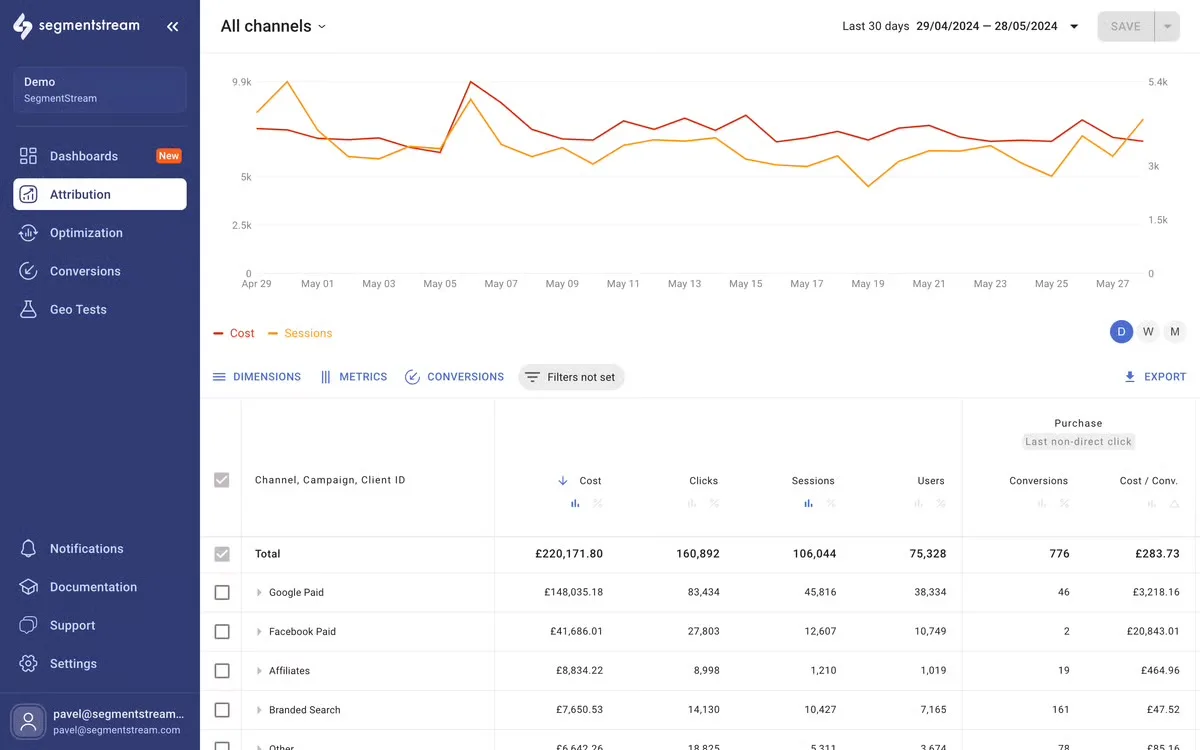
SegmentStream is an AI-powered attribution platform built for revenue teams spending $50,000 or more per month on digital ads. It combines multi-touch attribution with predictive lead scoring and incrementality testing in one platform.
Unlike tools that stop at reporting, SegmentStream connects measurement directly to budget decisions, recommending where spend should shift based on what the attribution data actually shows.
Key Features
- AI-Powered MTA: Uses custom attribution modeling based on actual behavioral signals for more accurate credit assignment
- Predictive Lead Scoring: Scores leads at first conversion to prioritize the highest-value accounts
- Incrementality Testing: Validates which channels are genuinely driving growth versus converting anyway
- Budget Optimization: Recommends how to reallocate spend across channels based on attribution data
- Value-Based Bidding: Optimizes Google and Meta bids toward pipeline value rather than generic conversions
Pricing
SegmentStream publishes three tiers: Online (digital-only conversions) starts at $800/month, Full Funnel (CRM-based sales) starts at $1,200/month, and Enterprise starts at $5,000/month with dedicated security and support.
Pros
- Most advanced attribution methodology available
- Combines attribution with budget optimization
- Transparent credit assignment per behavioral signal
Cons
- High price excludes smaller teams
- Requires significant ad spend to justify
Ratings
- G2: 4.7/5. Users highlight attribution depth and the optimization layer, though pricing requires a sales conversation.
What users say: Reviewers credit it with clarifying budget allocation, calling it “a single source of truth for Marketing efforts”
8. CaliberMind
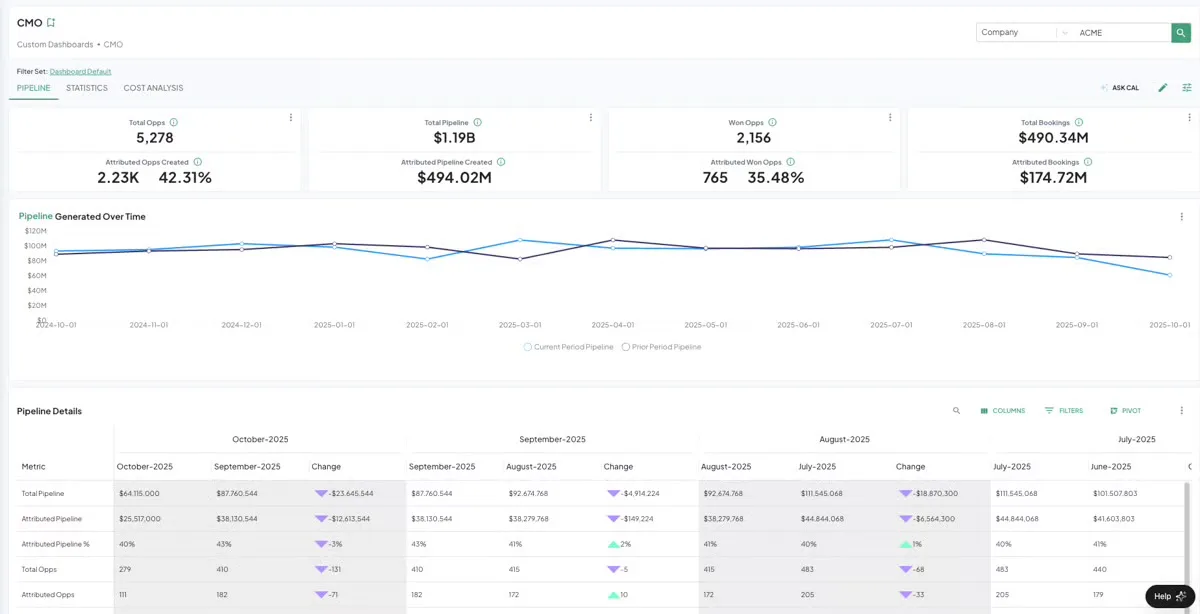
CaliberMind is a GTM intelligence and multi-touch attribution platform built for enterprise B2B organizations with fragmented data across multiple tools. It connects 170+ integrations and runs continuous data normalization to deduplicate records and build a unified buyer journey before attribution begins.
For teams dealing with messy data across multiple CRMs and ad platforms, CaliberMind solves the unification problem first.
Key Features
- 170+ Integrations: Connects more data sources than most tools with continuous deduplication and normalization
- Markov Chain Attribution: Applies statistical modeling for more rigorous credit assignment
- Unified Buyer Journey: Merges fragmented CRM, MAP, and ad data into a single account-level view
- AI-Assisted Reporting: Generates role-based dashboards and buyer journey summaries automatically
- Predictive Analytics: Uses historical patterns to forecast which accounts are most likely to convert
Pricing
CaliberMind uses custom pricing based on organization size and feature requirements. Contact CaliberMind directly for a quote.
Pros
- Handles complex enterprise data environments
- Markov chain attribution adds statistical rigor
- 170+ integrations cover any B2B stack
Cons
- Steep learning curve for new users
- Limited prescriptive budget optimization
Ratings
- G2: 4.5/5. Users praise reporting flexibility and data unification, though initial setup takes time.
What users say: Reviewers highlight attribution accuracy and frequent product updates, while noting onboarding takes time.
9. Heeet
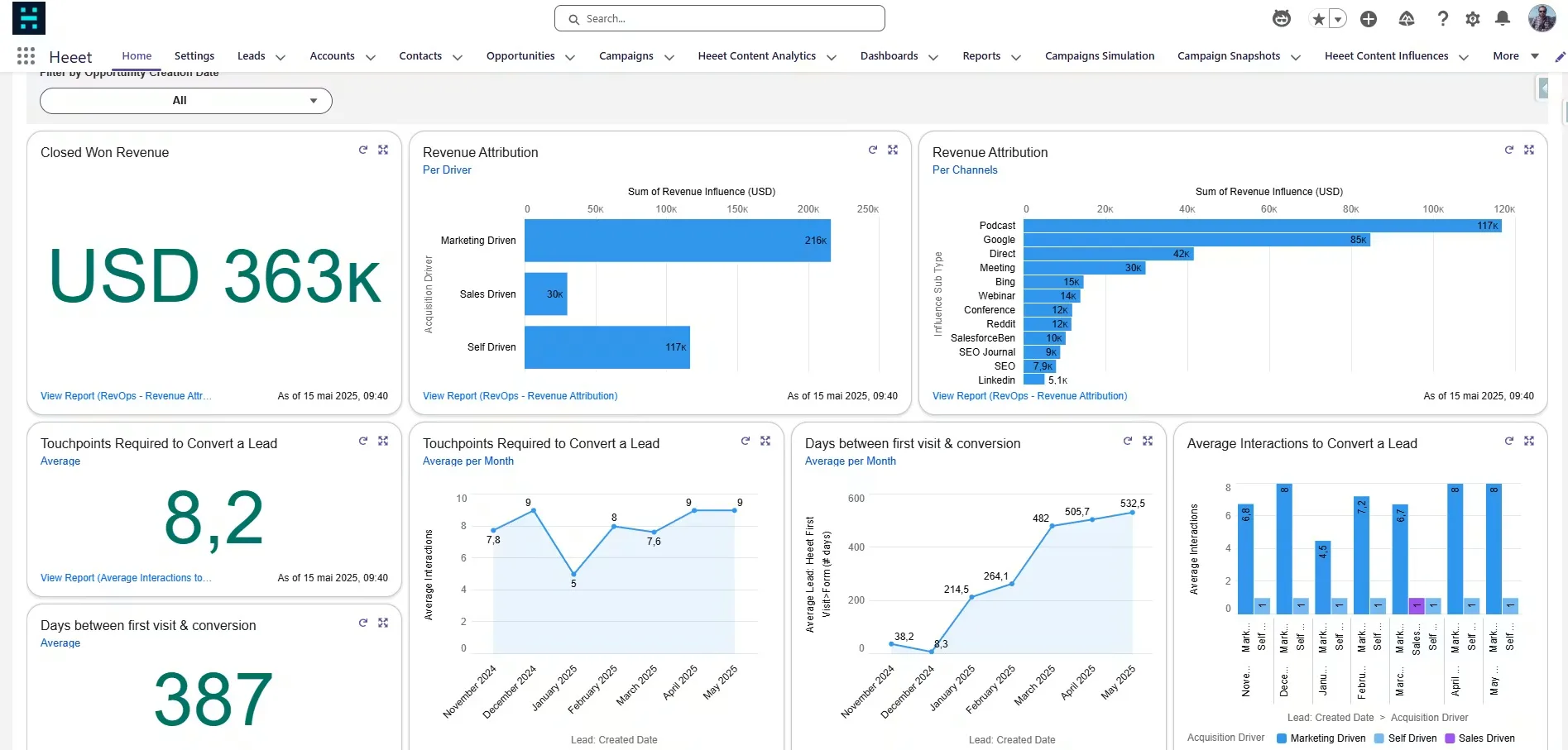
Heeet is a B2B revenue attribution platform built natively for Salesforce and HubSpot. Rather than sending data to a separate dashboard, it stores attribution on standard CRM objects so teams work inside systems they already use daily.
For B2B teams that want attribution to live inside their CRM rather than requiring a separate login, Heeet offers a meaningfully different architecture from every other tool on this list.
Key Features
- CRM-Native Attribution: Runs entirely inside Salesforce and HubSpot on native CRM objects
- Multi-Touch Models: Supports first-touch, last-touch, linear, U-shaped, and custom models inside the CRM
- Campaign Influence Reporting: Tracks how campaigns influence pipeline directly within CRM dashboards
- Offline Conversion Tracking: Connects offline events like trade shows to pipeline and revenue in the CRM
Pricing
Heeet starts at $790 per month for the Platform plan (any CRM), with the Native plan (built directly into Salesforce or HubSpot) at $1,490 per month, and custom pricing for larger Enterprise deployments.
Pros
- CRM-native, no separate dashboard needed
- Published pricing, no sales call required
- No context switching between systems
Cons
- Limited to Salesforce or HubSpot users
- Higher entry price than mid-market tools
Ratings
- G2: 4.8/5. Users value the CRM-native approach and pricing transparency, praising the elimination of a separate reporting layer.
What users say: Reviewers value the Salesforce-native setup and hands-on support through implementation.
10. HubSpot Marketing Hub
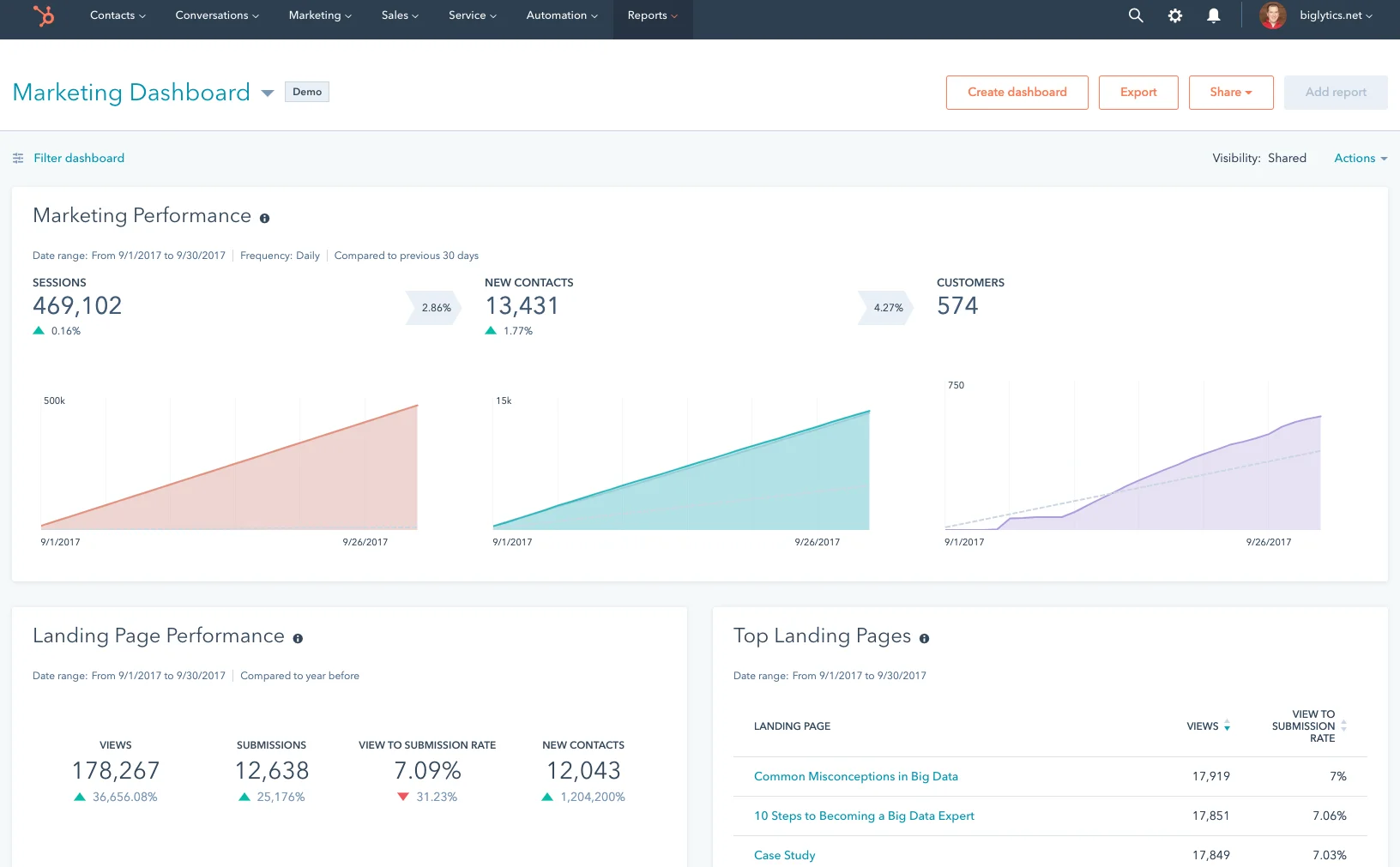
HubSpot Marketing Hub connects marketing data directly to a CRM to track the customer journey. It combines email, social media, and ads into one view to show what drives sales.
The platform uses flexible attribution models, including first-touch and multi-touch, to help teams see which channels find leads and close deals.
Key Features
- Omni-Channel Tracking: Tracks ads and interactions across video, mobile, and social media.
- Revenue Analytics: Shows exactly how marketing programs drive revenue and return on investment.
- Lead Management: Organizes your marketing lead database and segments users for better targeting.
Pricing
HubSpot offers four pricing tiers:
- The Free plan includes basic marketing tools and up to 2 users.
- Starter begins at $7/mo per seat to remove branding and increase limits.
- Professional starts at $800/mo for omni-channel automation.
- Enterprise starts at $3,600/mo for advanced governance, multi-touch revenue attribution, and journey analytics.
Pros
- Native integration connects all marketing tools in one platform.
- Real-time analytics support quick data-based decisions.
- Direct links between marketing actions and sales deals demonstrate ROI.
Cons
- Multi-touch revenue attribution is restricted to the expensive Enterprise plan.
- Advanced journey analytics are locked behind the Enterprise tier.
Ratings
- G2: 4.4/5. Users value the all-in-one capabilities but frequently complain about the high price.
What users say: Reviewers value having every marketing tool in one dashboard, though price is the most common complaint.
11. Cometly
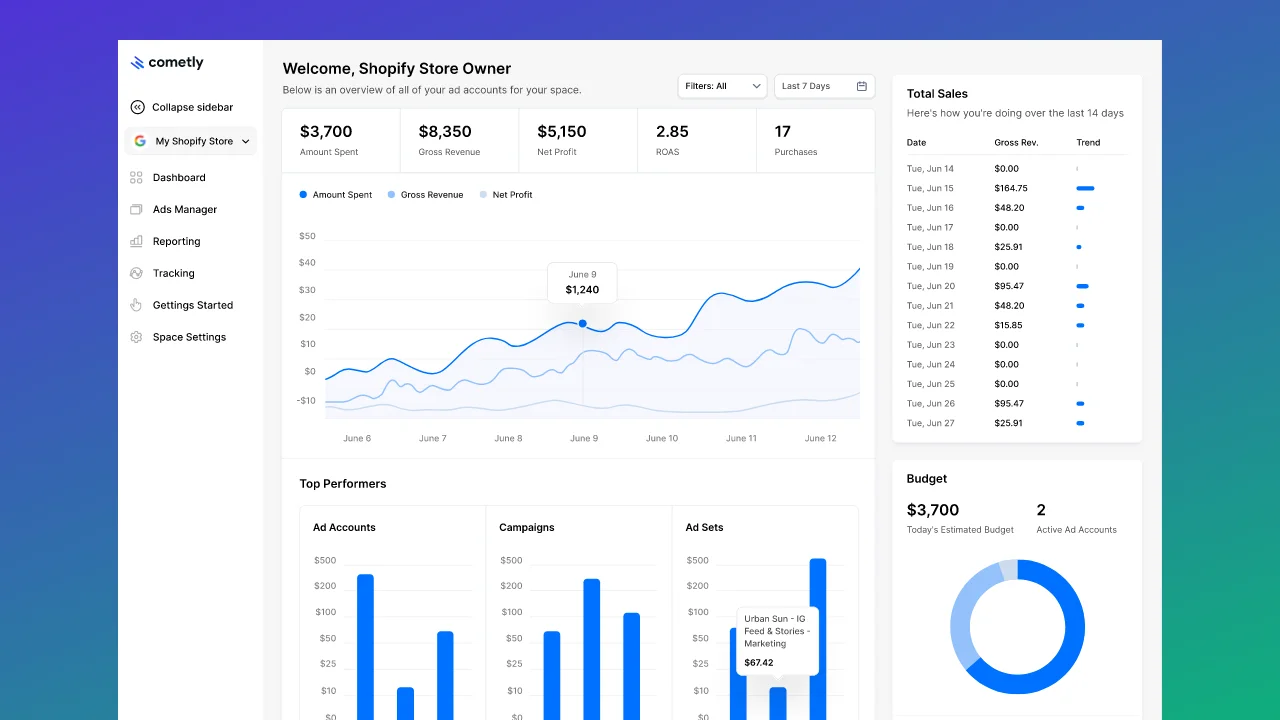
Cometly is a server-side attribution platform that restores data visibility lost to iOS privacy updates and ad blockers. It bypasses standard browser pixels to capture accurate conversion data and syncs it directly back to your ad platforms.
Key Features
- Server-Side Tracking: Uses a special tracking method to record data directly from the server, which is more accurate than standard browser pixels.
- AI Ads Manager: Uses artificial intelligence to analyze data and automatically optimize your ad campaigns for better performance.
- Conversion Sync: Sends verified sales data back to your ad platforms so their algorithms can find more customers.
- Offline Attribution: Tracks sales that happen offline or through events to give a complete picture of your marketing results.
Pricing
Cometly offers a unified custom plan that includes real-time organic and paid ads attribution, multi-touch models, AI ad optimization, and a dedicated onboarding team.
Pros
- The setup process is simple and easy to follow.
- Accurate tracking helps optimize ad spend.
Cons
- Setup takes time for businesses with complex technical stacks.
- Dashboard loading speeds are occasionally slow.
Ratings
- G2: 4.8/5. Users highly rate the accurate tracking and ease of setup but note that complex setups can be difficult.
What users say: Reviewers focus on tracking accuracy and minimal setup, noting that “with just one simple code and a few clicks, you get highly precise tracking”
12. Windsor.ai
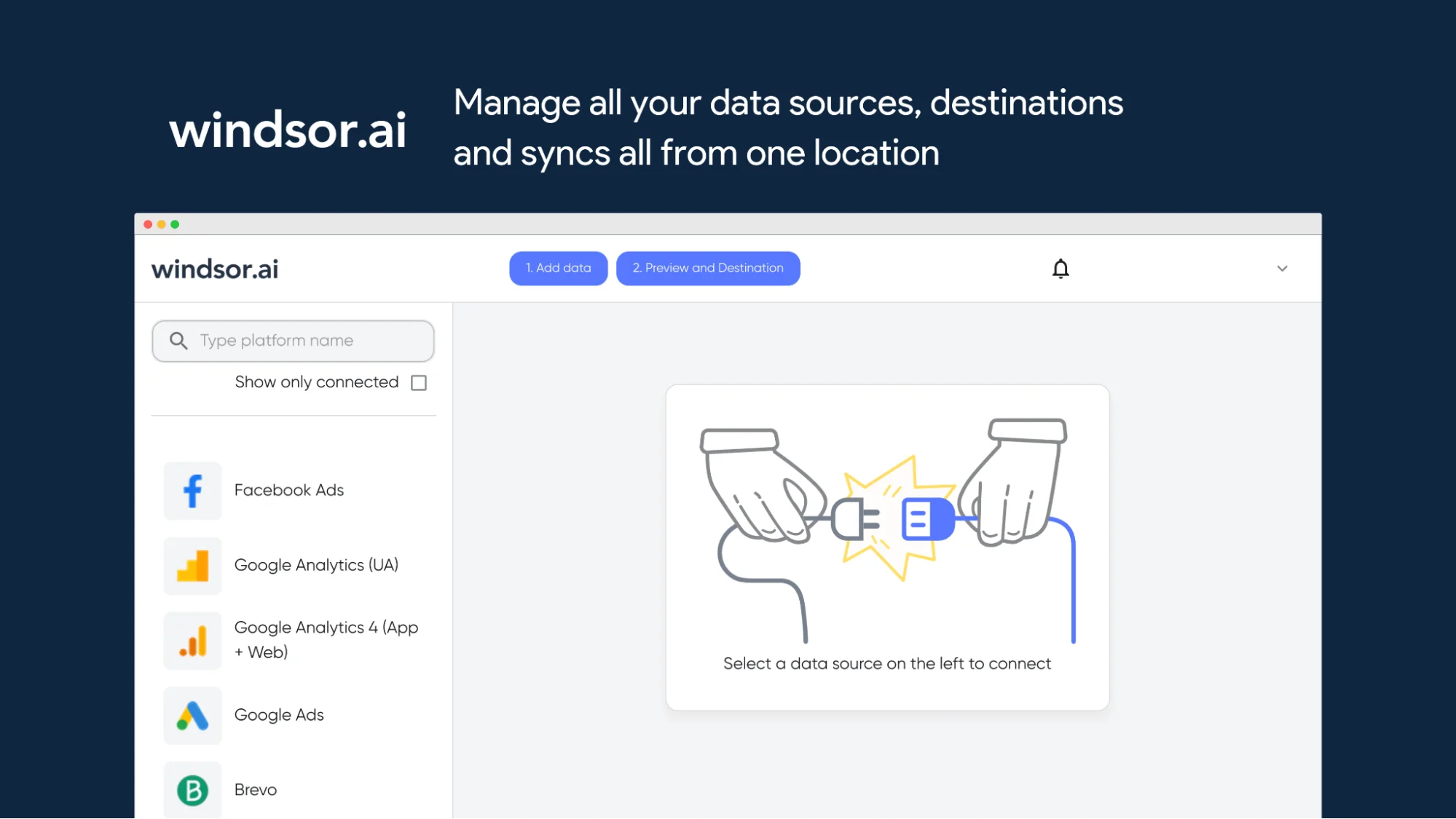
Windsor.ai is a data integration tool that connects your marketing data to reporting platforms. It pulls information from over 325 sources like Facebook Ads and Google Analytics and sends it directly to tools like Power BI, Looker Studio, or Excel.
This tool is a strong choice for data analysts and marketing teams that need to build custom reports in their own business intelligence software.
Key Features
- Data Connectors: Automatically syncs data from hundreds of platforms including HubSpot, Salesforce, and TikTok Ads.
- Multi-Destination Support: Streams your data to popular destinations like Google Sheets, Snowflake, BigQuery, and Tableau.
- Customer Journey: Unifies user data across different devices to recognize returning users and track their path.
- Automated Reporting: Schedules data refreshes so your dashboards always show the most current information without manual work.
Pricing
Windsor.ai offers several pricing tiers to fit different data needs:
- Free is for 1 user and limited data sources.
- Basic costs $19/mo for unlimited users and 3 data sources.
- Standard is $99/mo for 7 data sources and 75 accounts.
- Plus is $249/mo for 10 data sources and 200 accounts.
- Professional is $499/mo for 14 data sources and larger volume needs.
Pros
- Simplifies data integration by pulling metrics into one dashboard.
- Customer support resolves technical issues quickly.
- Automated data syncing saves time compared to manual reporting.
Cons
- The interface is difficult for beginners to navigate.
- Connectivity glitches occur with specific data connectors.
- Documentation lacks the depth needed for complex troubleshooting.
Ratings
- G2: 4.6/5. High marks for ease of use and support, though some users find the initial learning process difficult.
What users say: Reviewers cite value for money and connector breadth, with one saying “Windsor is great for UA and Growth Enthusiasts”.
13. Attribution
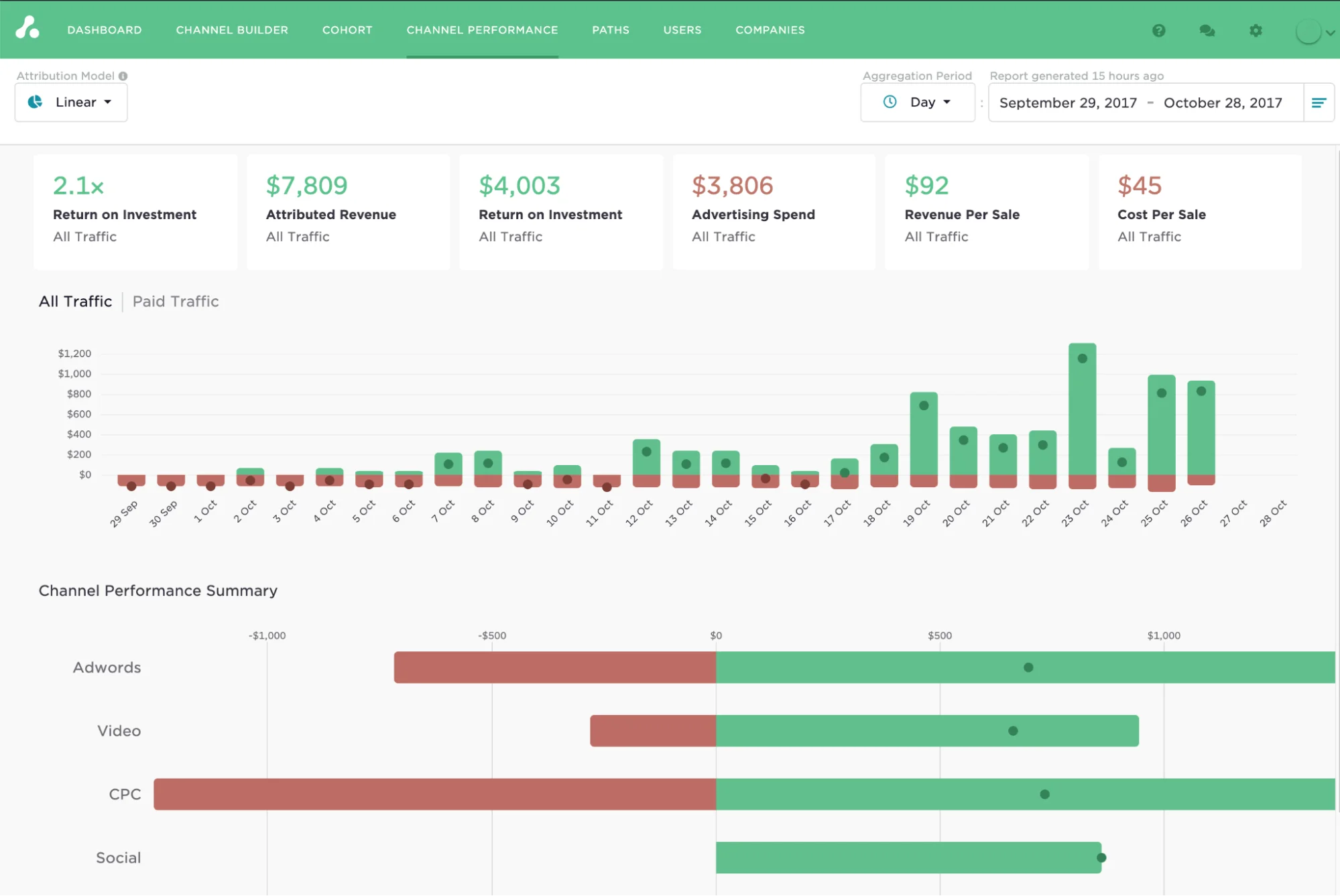
Attribution is a multi-touch attribution platform that tracks marketing performance from the first visit to the final sale. It connects ad spend, site visits, and revenue in one view to show exactly which channels make money.
This tool is a good fit for growing B2B and SaaS teams that need to track complex customer journeys and measure return on ad spend without a large data team.
Key Features
- Ad Connectors: Automatically syncs cost and performance data from major platforms like Facebook, Google, and LinkedIn.
- Cohort Reporting: Displays return on ad spend by channel over specific days, weeks, or months for deeper analysis.
- Granular Metrics: Tracks critical business numbers like Customer Acquisition Cost (CAC) and Lifetime Value (LTV) in real time.
- Account-Based Tracking: Monitors activity at both the individual user level and the company account level.
Pricing
Attribution offers two main pricing plans:
- Pro starts at $399 per month for growing teams and includes up to 10,000 monthly tracked users.
- Enterprise is a custom plan for larger needs that includes advanced security, data warehouse tooling, and unlimited seats.
Pros
- Interface is simple and easy to navigate.
- Customer support assists effectively during setup.
- Detailed insights help optimize ad budgets.
Cons
- Data loading is slow when processing large reports.
- Integrating specific marketing tools requires technical skill.
- Data export options are limited.
Ratings
G2: 4.5/5. High marks for ease of use and support, though speed can be an issue.
What users say: Reviewers describe a simple interface and a team “actively working on and improving their product”
14. InfiniGrow
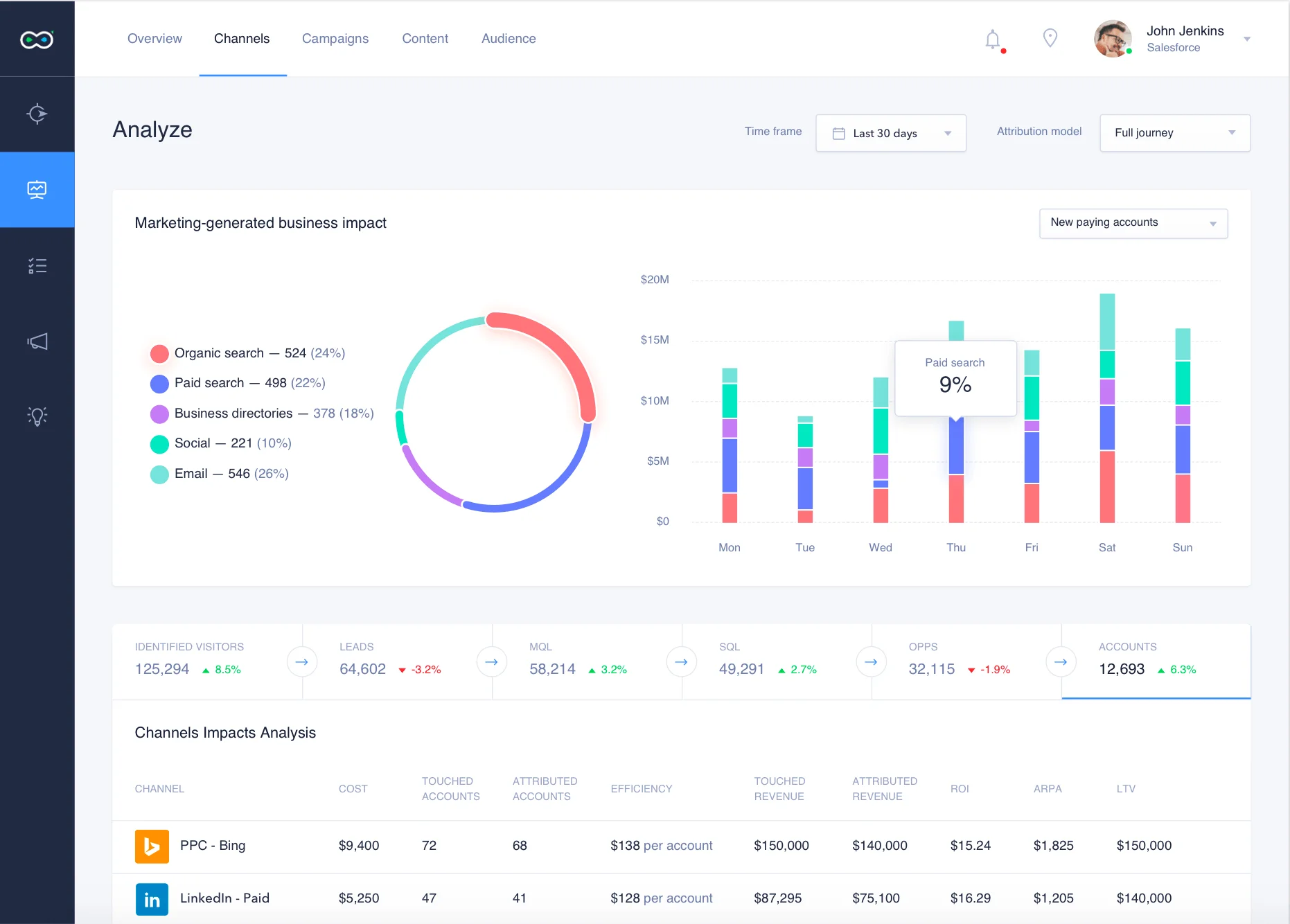
InfiniGrow focuses on AI-driven budget allocation and forecasting for B2B marketers. It combines attribution, planning, and revenue analysis into one solution to help teams optimize their spending.
This tool is a strong choice for B2B SaaS companies that want to move beyond simple tracking and use artificial intelligence to decide where to invest their budget for the best returns.
Key Features
- Unified Data: Centralizes marketing, sales, and financial data into a single view to fix disconnected tracking.
- AI Budget Allocation: Uses artificial intelligence to recommend the best ways to split your budget across different channels.
- Forecasting: Predicts the likely results of different budget scenarios so you can build more accurate plans.
- Performance Benchmarking: Compares your actual results against your goals to keep strategies on track.
Pricing
InfiniGrow offers three pricing tiers based on the maturity of the business:
- The startup tier is $1,500 per month (paid annually) and includes 7 integrations and daily data updates.
- The Growth tier is $4,500 per month (paid annually) and adds unlimited integrations, hourly data updates, and AI budget suggestions.
- The Enterprise tier is a custom plan for large organizations that need dedicated support and multiple business units.
Pros
- The interface is simple to navigate.
- Insights align marketing and sales teams on goals.
- Forecasting tools predict outcomes before the budget is spent.
Cons
- Filtering data to find specific details is difficult.
- New users require time to adapt to the system workflow.
Ratings
- G2: 4.7/5. Users value the ability to connect budget directly to revenue, though the initial learning process takes time.
What users say: Reviewers point to event visibility, with one saying “InfiniGrow has allowed me to clearly prove the value of our events”
15. LeadsRx
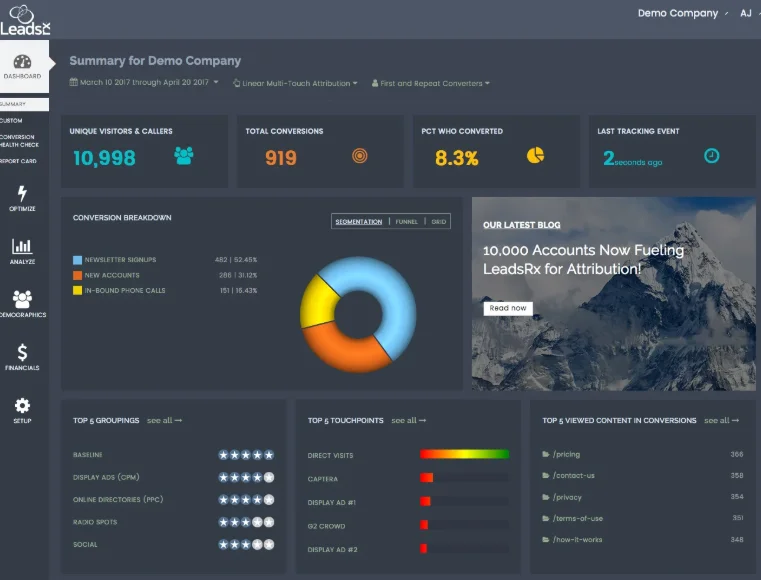
LeadsRx is a marketing platform that tracks performance across both digital and traditional channels. It uses a universal pixel to connect customer journeys across devices, browsers, and offline media like radio and TV.
This tool is best for brands and agencies that need to measure the combined impact of mixed media campaigns alongside their digital ads.
Key Features
- Cross-Channel Tracking: Measures the performance of marketing across digital, radio, TV, podcasts, and OTT streaming services.
- Universal Pixel: Uses a single tracking pixel to collect data and stitch together customer paths across different devices.
- ROAS Reporting: Calculates the specific Return on Ad Spend for every channel to show which budgets are working best.
- Agency Capabilities: Provides dedicated tools for agencies to manage attribution and reporting for multiple clients at once.
Pricing
LeadsRx uses a custom pricing model divided into three specific solutions:
- LeadsRx Attribution is designed to evaluate campaign performance and optimize return on ad spend across all touchpoints.
- LeadsRx Journey focuses on understanding consumer relationships and building a database of first-party data.
- Attribution for Agencies is a dedicated solution built to help agencies manage client success and prove campaign value.
Pros
- Connects offline ads like radio directly to website traffic.
- Tracks complex campaigns across many media types easily.
- Agencies can demonstrate value to clients with clear reports.
Cons
- Integration requires specific technical steps that are difficult to manage.
- Client onboarding delays occur due to technical requirements.
Ratings
- G2: 4.4/5. Users value the unique ability to track offline media but note that the setup requires significant effort.
What users say: Reviewers value the mixed-media view and the range of data cuts available for client reporting.
16. DemandSense
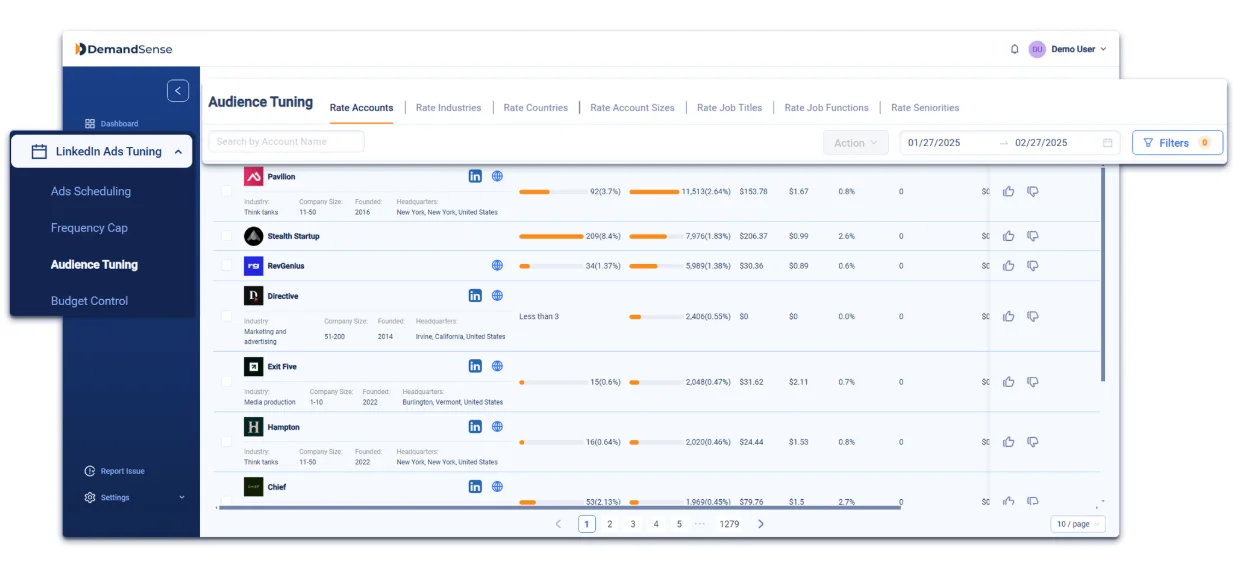
DemandSense is a platform built specifically for marketing teams and agencies that run ads on LinkedIn. It helps you find out which companies are clicking your ads and visiting your website so you can target them better. In 2026 it also added revenue attribution, which connects LinkedIn activity to deals in HubSpot, Salesforce or Attio, and an MCP server.
Key Features
- Sense Demand: Unmasks anonymous website visitors to reveal which companies are showing buying signals.
- Audience Tuning: Builds strategic audiences using detailed filters like demographics and firmographics to group high potential accounts.
- Smart Ad Scheduling: Automatically reallocates budget and schedules ads to prevent fatigue and save money.
- Account Based Marketing: Uploads high intent leads directly to LinkedIn for precise retargeting campaigns.
Pricing
DemandSense offers two pricing tiers to suit different needs:
- DemandSense Base is $89 per month with 200 credits a month.
- DemandSense Plus is $149 per month with 500 credits a month and higher limits for visitor ID and audiences.
Both plans include ad scheduling, frequency caps, audience tuning, website visitor ID and revenue attribution, and both come with a 30-day free trial.
Pros
- Automating budget allocation improves efficiency.
- Engagement features connect teams with high-intent buyers quickly.
- Campaign management tools centralize LinkedIn ad oversight.
Cons
- Managing complex features requires a time investment.
- Resolving technical issues requires support team assistance.
Ratings
- G2: 5.0/5. Users praise the efficiency but note the difficulty in getting started.
What users say: Reviewers frame it as a control layer, describing it as “the missing layer between LinkedIn campaigns and actual control”
17. Adobe Marketo Measure
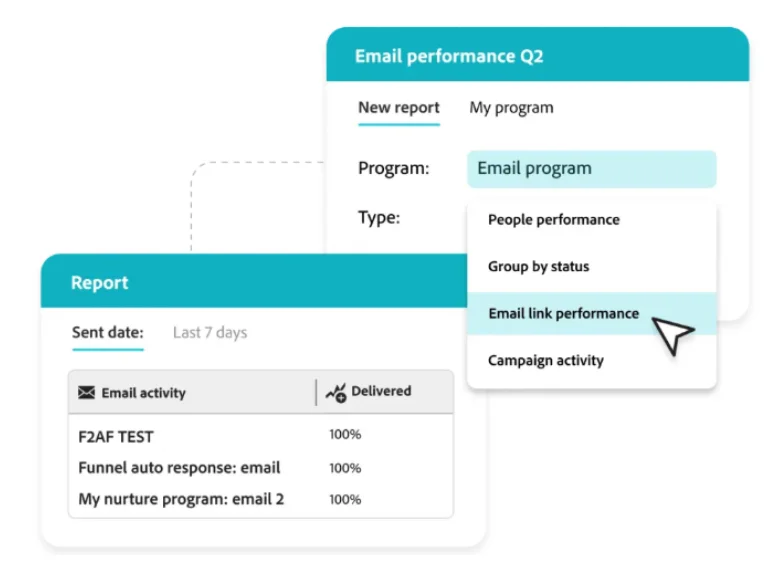
Adobe Marketo Measure, formerly Bizible, is Adobe’s enterprise B2B attribution platform. It tracks touchpoints across paid media, email, and webinars alongside offline channels like events and direct mail, then ties them back to CRM pipeline and revenue. If you already run Adobe Experience Cloud it plugs straight in, but cost and complexity keep it in enterprise territory.
Key Features
- Every-Touch Attribution: Tracks paid media, email, webinars, events, and direct mail in one view.
- Attribution AI: Uses machine learning to assign credit across the journey instead of fixed rules.
- Flexible Data Framework: Customize channel hierarchies and buyer stages to match how you sell.
- Role-Based Dashboards: Pre-built reporting views for CMOs, channel marketers, and analysts.
Pricing
Adobe does not publish pricing. Marketo Measure is sold within Adobe Experience Cloud and bundled with the highest Marketo Engage tier, so expect enterprise-level investment and a quote.
Pros
- Covers online and offline touchpoints in a single model.
- Machine learning removes manual model configuration.
- Deep integration with Adobe Experience Cloud and Salesforce.
Cons
- No public pricing and an enterprise-level budget requirement.
- Implementation often takes months.
- Full value depends on staying inside the Adobe ecosystem.
Ratings
- G2: 4.7/5
What users say: Reviewers value the revenue clarity but flag setup complexity, with one noting “it clearly shows which marketing efforts actually influence deals and revenue”
18. RevSure
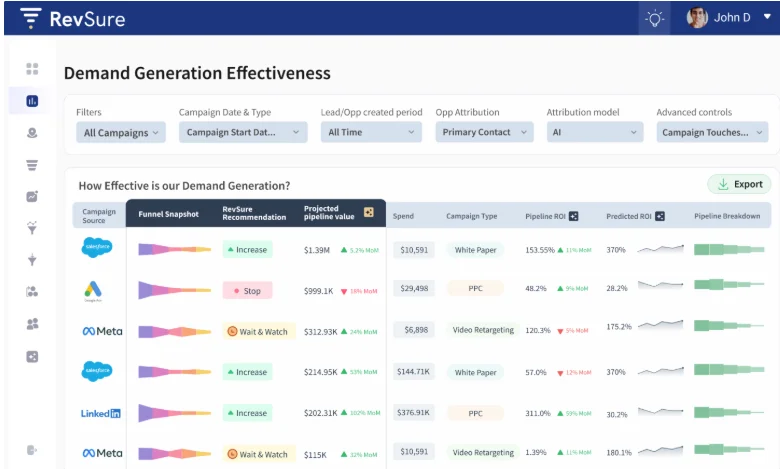
RevSure calls itself a context layer for go-to-market AI. It unifies CRM, marketing automation, ad platform, and warehouse data into one graph, then runs AI agents on top to automate budget reallocation and deal-risk scoring. It covers first, last, linear, time decay, W-shaped, and J-shaped models, but attribution is one module inside a broader revenue intelligence platform.
Key Features
- Data Harmonization: Unifies CRM, MAP, ad, and warehouse data into one graph without migration.
- Agentic AI: Pre-built agents for reallocation, deal risk, and deanonymization.
- Pipeline Forecasting: Projects pipeline up to four quarters out so you can flag shortfalls early.
- Identity Resolution: Stitches anonymous and known account data across systems.
Pricing
RevSure publishes its pricing:
- Early Adopter is $4,000/month for 50,000 contacts, 10 users, and 4 AI agents.
- Growth is $6,000/month for 200,000 contacts, 20 users, 8 agents, and the agent builder.
- Enterprise is custom, from 500,000+ contacts with warehouse access.
- White-glove deployment is included on every plan.
Pros
- Attribution, forecasting, and AI agents in one platform.
- SOC 2 Type II, ISO 27001, and ISO 42001 certified.
- Deployment support included on all plans.
Cons
- The $4,000/month entry price rules out smaller teams.
- No free trial advertised.
- Newer platform with a smaller review base than established tools.
Ratings
- G2: 4.7/5
What users say: Reviewers highlight funnel visibility despite a learning curve, citing “a granular view into campaign performance and funnel metrics”
19. Triple Whale
Triple Whale is an attribution and analytics platform built for ecommerce and DTC brands. Its first-party Triple Pixel and server-side tracking capture touchpoints across devices, then connect to your ad platforms and Shopify store. If you sell through Shopify it does that job well. If your revenue runs through a CRM-based B2B sales cycle, it is not built for that workflow.
Key Features
- Triple Pixel: First-party, server-side tracking that survives iOS privacy changes.
- Marketing Mix Modeling: Combines MMM and incrementality testing with multi-touch attribution on Enterprise.
- Creative Analytics: Breaks performance down by individual ad creative.
- Moby AI: An AI operator on live store data that runs analysis and automates recurring work.
Pricing
Pricing combines annual GMV with the package you choose. At the lowest GMV tier:
- Free covers channel tracking, first and last-click attribution, 10 users.
- Foundation adds multi-touch attribution, custom dashboards, and Moby; Triple Whale does not publish a flat price for this tier, so it requires a quote.
- Automate adds automations and Moby specialist agents; this tier is also quote-only, with no published flat price.
- Enterprise is custom, adding Compass for MMM, MTA, and incrementality testing.
- Costs rise with GMV. Paid plans are 12-month terms, billed monthly or annually.
Pros
- Strong first-party tracking around iOS privacy restrictions.
- Attribution, creative analytics, and AI in one platform.
- Genuinely useful free tier.
Cons
- Built for ecommerce and DTC, not CRM-based B2B sales cycles.
- Pricing scales with GMV, so cost rises with revenue.
- Shopify-first, so other storefronts get less value.
Ratings
- G2: 4.5/5
What users say: Reviewers praise the unified dashboard, though attribution accuracy draws complaints, with one saying “it’s made attribution so much clearer”
Choose the Best B2B Attribution Tool for Your Business
The right B2B marketing attribution software connects your ad spend to revenue so you can see exactly what works. DemandSense specializes in analyzing LinkedIn audiences, while Cometly focuses on tracking. Fibbler combines these features; It identifies the companies clicking your ads and syncs the data to your CRM so you can block bad traffic immediately to save budget.
Across all 19 tools, the right pick depends on your stack. Adobe shops will look at Marketo Measure, RevOps teams wanting AI agents at RevSure, and Shopify brands at Triple Whale.
Teams on Unlimited and Agency plans can also query that attribution data directly inside Claude or ChatGPT using Fibbler's LinkedIn Ads MCP Server or Google Ads MCP Server, no exports required. Meta Ads data is available there too.
Get started with Fibbler for free.
FAQs
What is the difference between first-touch and multi-touch attribution in B2B?
First-touch gives 100 percent of conversion credit to the first marketing interaction. Multi-touch distributes credit across every touchpoint in the buyer journey. For B2B companies with long sales cycles and multiple decision-makers, multi-touch attribution gives a far more accurate picture of which channels are genuinely contributing to revenue.
How does B2B marketing attribution work with long sales cycles?
Attribution software tracks every interaction from the first ad impression to the final CRM close and connects them into a unified account-level journey. This allows revenue teams to see which campaigns influenced deals that closed months later, not just which campaigns drove last-week form fills or website visits.
Does B2B marketing attribution software integrate with Salesforce and HubSpot?
Yes, most leading B2B marketing attribution platforms offer native integrations with both Salesforce and HubSpot. Tools like Fibbler automatically sync company-level ad engagement directly into your CRM, while platforms like Heeet run natively inside them. This ensures seamless tracking across your existing sales and marketing tech stack.
How much does B2B marketing attribution software cost?
Pricing varies significantly by software and use case. Fibbler starts at $89 per month, making it one of the most accessible options for LinkedIn, Google, and Meta Ads attribution. Mid-market platforms like Dreamdata offer a free tier with custom pricing beyond that. Heeet starts at $790 per month, SegmentStream starts at $800 per month, and RevSure starts at $4,000 per month for teams wanting dedicated AI agents. Enterprise platforms like CaliberMind remain fully custom-quoted.
What is the best B2B attribution tool for LinkedIn Ads specifically?
Fibbler is the premier dedicated attribution tool for LinkedIn Ads. As an official LinkedIn Marketing Partner, it uses the Company Intelligence API to map account-level engagement data directly to CRM pipeline and revenue. It also features impression capping to prevent budget waste on accounts that aren't converting.
Can B2B attribution software track offline touchpoints like events and direct mail?
Some can. Ruler Analytics and Heeet both support offline conversion tracking, so you can tie event attendance or direct mail back to the campaigns that drove them. Adobe Marketo Measure also covers events and content syndication. If your mix includes in-person events, check this before you commit.
How long does it take to set up B2B marketing attribution software?
It depends on the tool. Fibbler connects to your CRM and LinkedIn Ads account in under 30 minutes with no dev resources. RevSure quotes two to three weeks. Enterprise platforms like CaliberMind or Adobe Marketo Measure can take months.
Do I need attribution software if I already use Google Analytics?
Google Analytics tracks website behavior but does not connect ad impressions to CRM pipeline or revenue. B2B attribution software fills that gap, linking ad platforms to your CRM so you can see which campaigns influenced closed deals. Most teams need both.
Written by

Adam Holmgren
CEO @ Fibbler

Prove paid ads drive pipeline
Fibbler helps you see which companies view or engage with your LinkedIn, Google and Meta Ads, and connect them to pipeline and revenue in your CRM.
Try 30 days for free
Prove paid ads drive pipeline
Fibbler helps you see which companies view or engage with your LinkedIn, Google and Meta Ads, and connect them to pipeline and revenue in your CRM.
Try 30 days for free