
Google Ads Attribution Models in 2026: Data-Driven vs. Last Click (And How to Fix Both)
Deciding on the right Google Ads attribution model used to mean relying on Time Decay and Linear models to value the early research steps that started the customer journey. Google has since removed these options pushing advertisers toward Data Driven Attribution by default.
Now, advertisers are restricted to choosing between this automated AI model and the simplicity of the Last Click model. If the model is wrong, you risk pausing the exact campaigns that drive your pipeline. This guide covers how to build a system that connects ad spend to closed deals instead of just lead volume.
Why Are Google Ads Attribution Models Important?
Google Ads attribution models help you measure the right data to prove which ads actually drive deals so you can allocate your budget without wasting it.
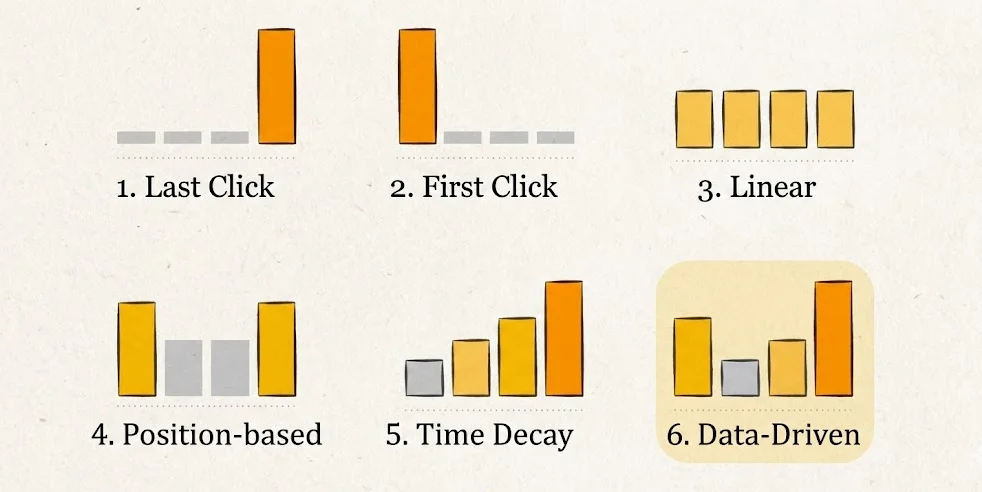
Here is exactly what accurate attribution delivers:
- Maximize ROI and Budget Allocation: You can identify exactly which keywords and ads contribute to conversions instead of only rewarding the final step. This allows you to reallocate your budget to the most effective channels.
- Accurate Performance Measurement: The right model prevents you from underestimating upper-funnel efforts. It reveals the true value of brand awareness campaigns that introduce customers to your brand but often do not receive the final credit.
- Improved Bidding Capabilities: Insights from these models enable the system to optimize bids more effectively. This ensures that automated bidding strategies rely on accurate performance data to improve campaign results.
- Data-Driven Decisions: The default Data-Driven Attribution model uses your historical conversion data to determine which interactions are influential. This bases your strategy on actual performance patterns rather than static rules.
Data-Driven vs. Last Click: The Two Remaining Models And When to Use Them
In October 2023, Google officially removed four attribution models: First Click, Linear, Time Decay, and Position-Based. The choice for 2026 effectively comes down to the AI-powered default and the conservative backup.
Here is how they work, their limitations, and when you should actually use them.
1. Data-Driven Attribution
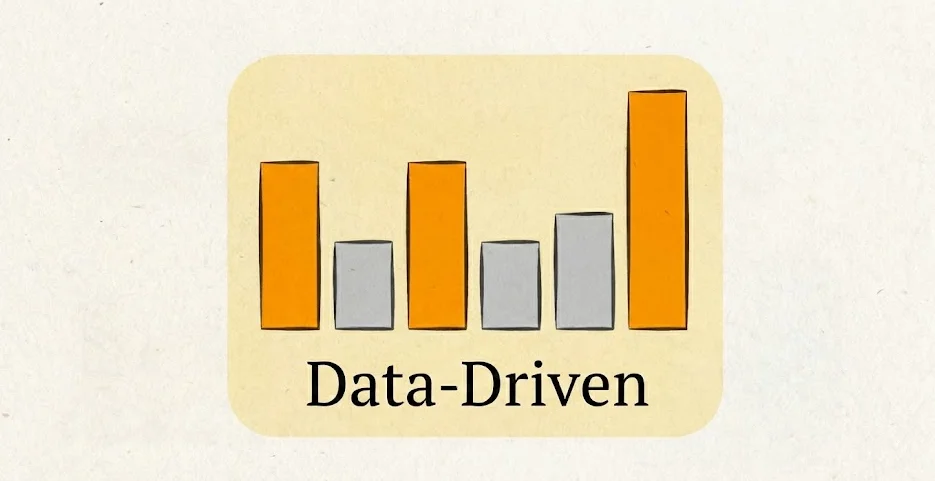
This is now Google's primary model. Instead of following a static rule, it uses machine learning to analyze your account's historical data. It looks at every interaction, including clicks, video views, and search patterns, to calculate the actual probability of a conversion.
How it works
The model compares the paths of customers who converted against those who didn't. It analyzes factors like the device used, the time between clicks, and the order of ad exposure. If the AI sees that users who click a specific ad are 20% more likely to convert later, it assigns partial credit to that interaction even if the final conversion happened on a different keyword weeks later.
The Limitation
You cannot see the math behind the decision. More importantly, this model relies entirely on the quality of the conversion data. It operates on a strict dependency where poor data quality guarantees poor optimization.
If your account records spam form fills or bot clicks as conversions, the AI treats them as success signals. It will then optimize your budget to find more of that low-quality traffic because it mimics the behavior of your best converters.
When to use it
This is the best choice for B2B advertisers with complex, multi-touch journeys provided you have a mechanism to filter out bad data before the AI sees it.
2. Last Click Attribution
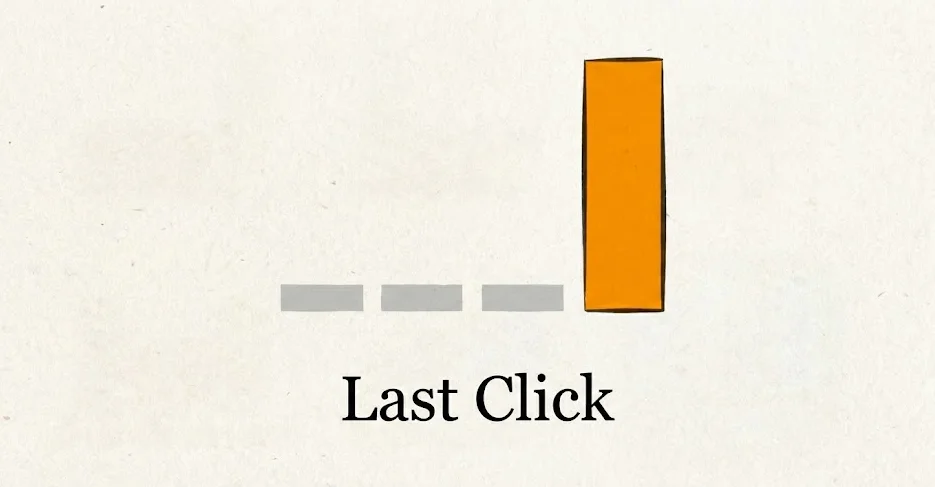
This is the traditional standard. It ignores every interaction in the customer journey except for the very final one. If a user clicks a display ad, reads three blog posts, and then searches your brand name to convert, the brand keyword gets 100% of the credit.
How it works
It is binary. The ad that closed the deal gets all the credit and the ads that introduced the brand get nothing.
The Limitation
It creates a blind spot for upper funnel activity. In B2B, the final click is often just a brand search. If you rely on the Last Click attribution model, you will see your top-of-funnel educational keywords as waste because they don't generate immediate leads. You might pause them not realizing they are the only reason people are searching for your brand in the first place.
When to use it
Use this only if you have very low data volume, or if you need a strictly conservative view of your budget to ensure you never overspend on assist keywords.
How to Compare and Switch Your Attribution Settings
For years, choosing a Google Ads attribution model meant guessing which static rule like Time Decay or Linear best matched your customer journey. The removal of these options means the choice for 2026 is binary between the AI powered Data Driven model and the legacy Last Click model.
While this simplifies the selection, it raises the stakes for data quality because feeding the AI bad data forces it to optimize for the wrong outcome. To avoid disrupting your pipeline, you should verify the impact of the default option on your actual data first.
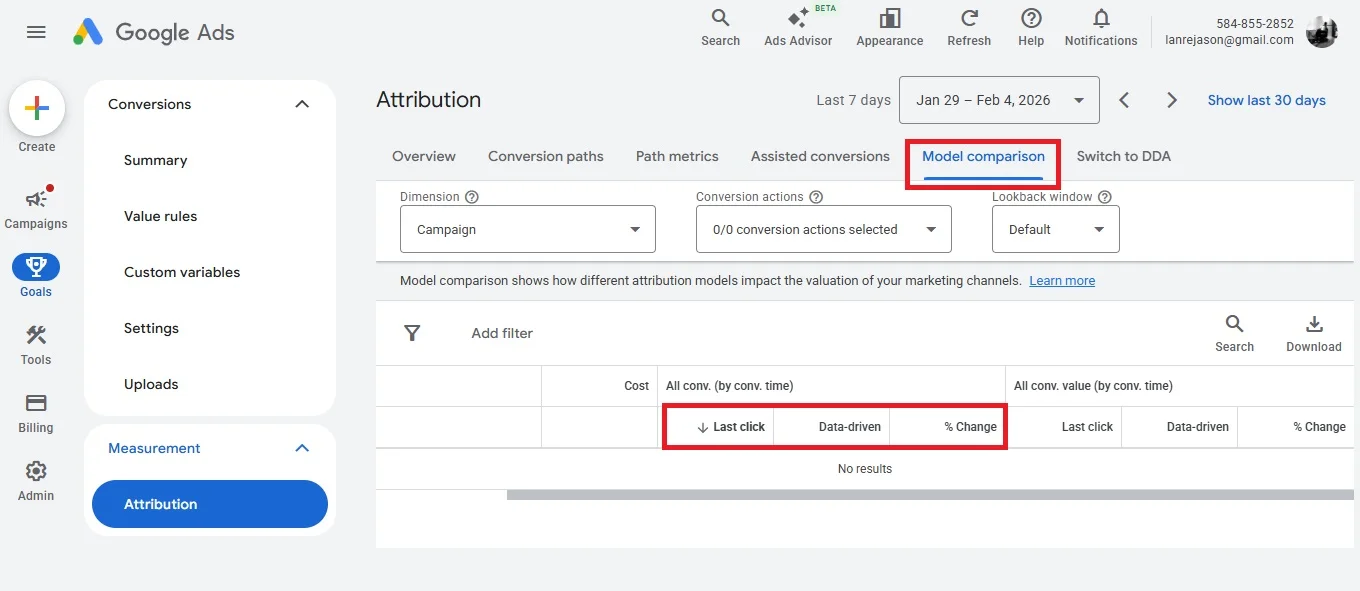
Start by assessing your current performance using the Model Comparison tool. You can access this by clicking the Goals icon in your Google Ads dashboard, selecting Measurement, and then clicking Attribution.
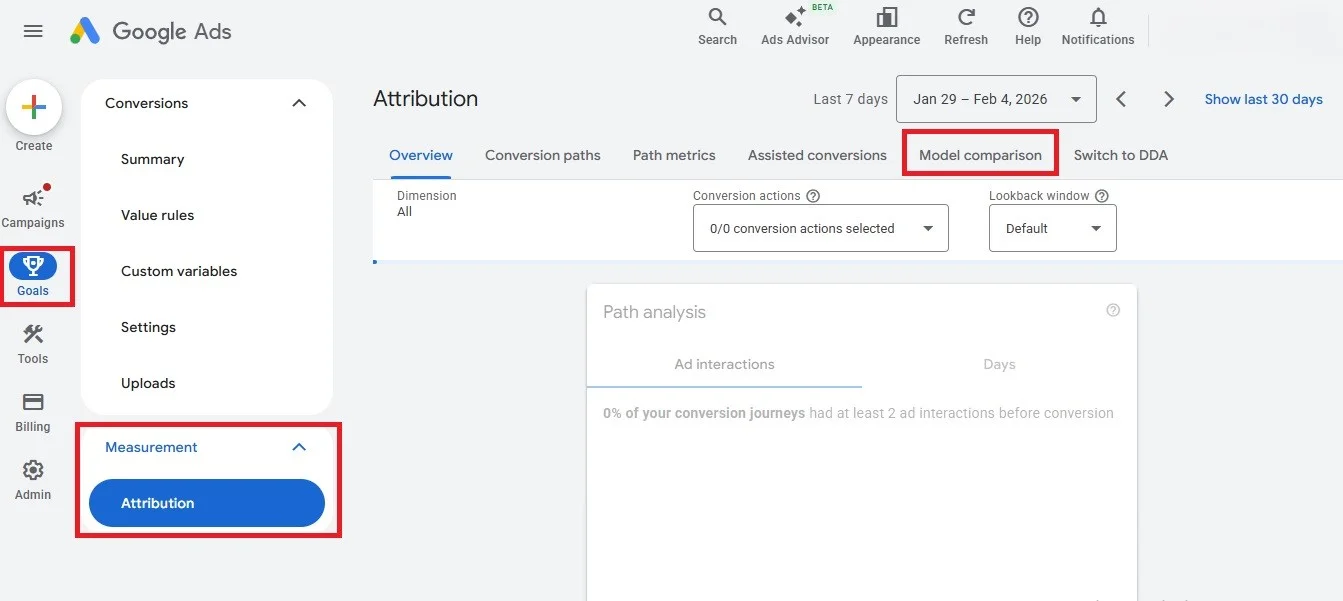
From here, select the Model comparison tab at the top of the page. This feature allows you to compare how conversion data would differ under various models without actually changing your settings.
For example, you can compare your current Last Click setup against Data-Driven Attribution to see exactly how your conversions and cost metrics would shift.
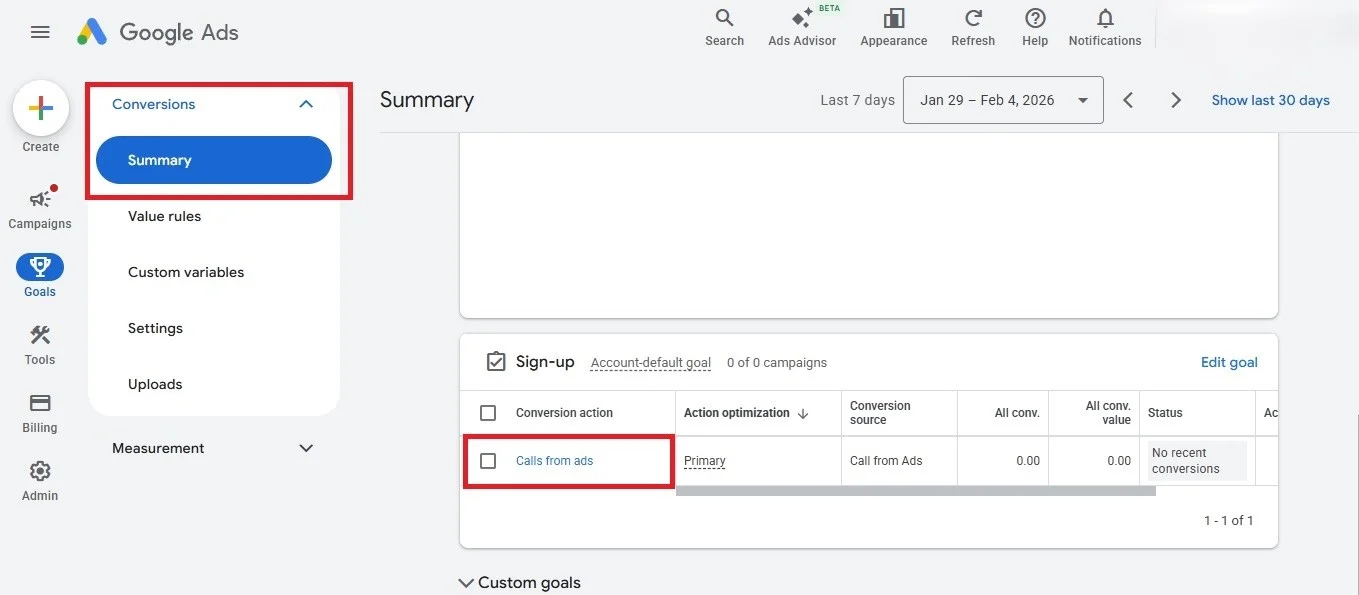
Once you have reviewed the comparison data and confirmed that a new model aligns with your strategy, you must apply the switch to each specific conversion action individually.
Navigate back to the Goals icon, select Conversions, and click on Summaryto view your active goals. Click on the name of the specific conversion event you want to update, such as your "Call from ads".
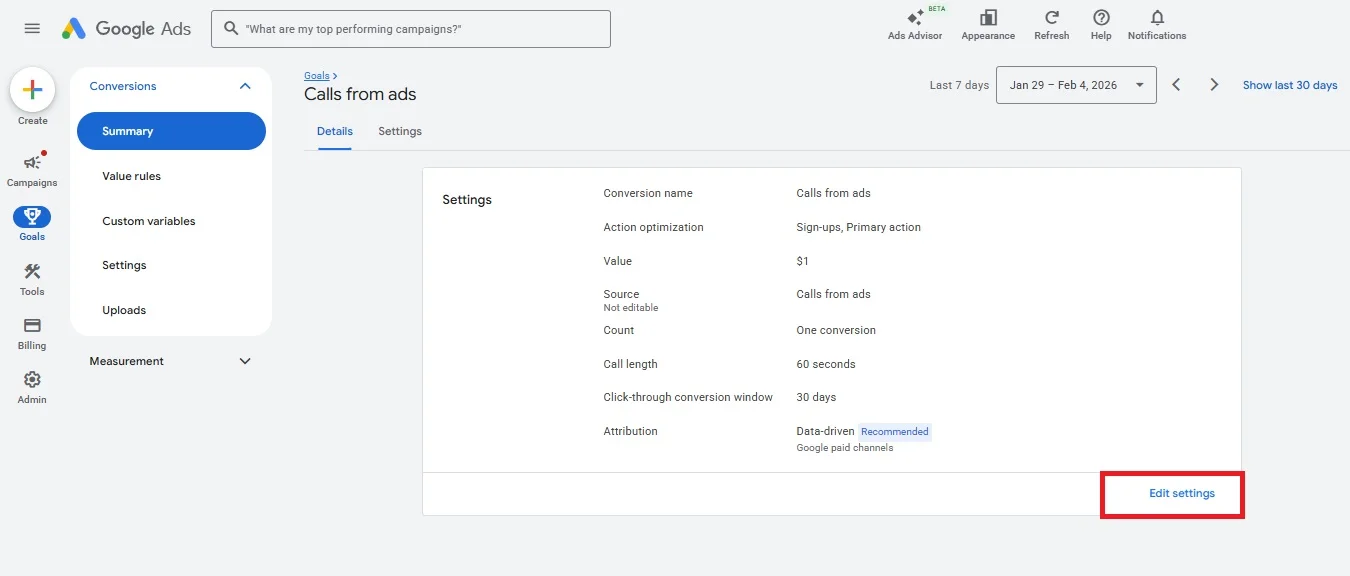
Once the conversion details page opens, look for the Edit settings link in the bottom right corner and click it to expand the options.
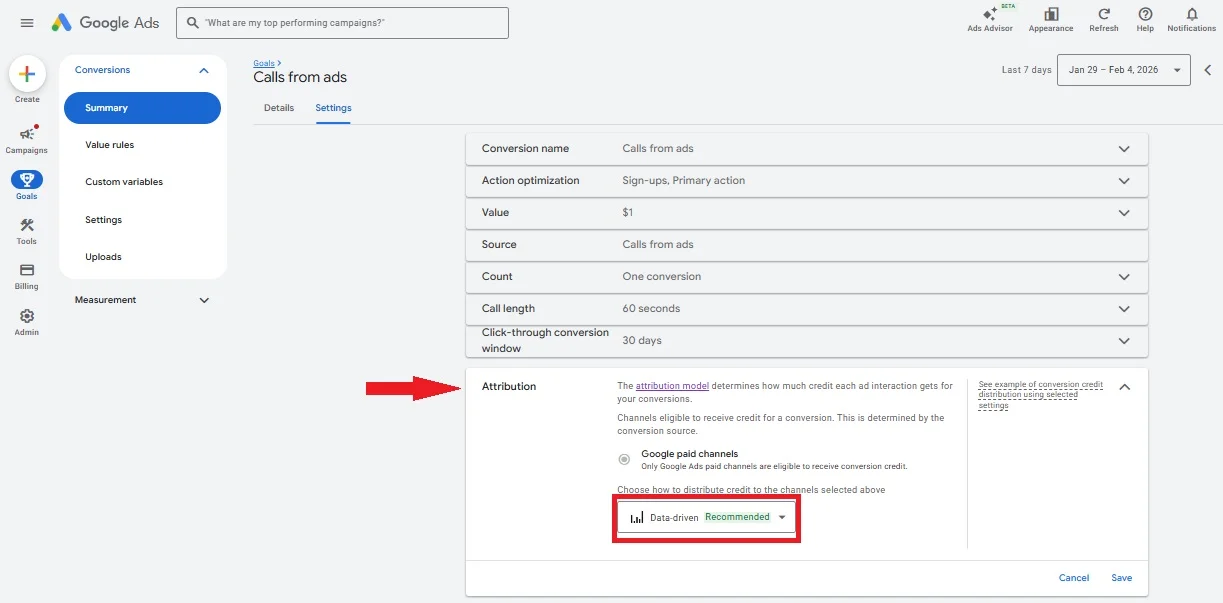
Scroll down to expand the Attribution section, switch the drop-down menu to your desired model, and click Save to finalize the change.
Regardless of which model you choose, they both share a critical dependency, which is the quality of the traffic. If you feed it spam, it will calculate a strategy based on spam.
What Affects Your Attribution Model Accuracy
Your attribution model relies on a continuous and clear signal to work correctly. While the quality of traffic is a major issue, it is not the only variable that can distort your data. Real-world limitations and technical gaps often prevent Google Ads from seeing the full picture of your customer journey.
Here are the primary factors that impact the accuracy of your attribution reporting:
- Data Inaccuracy and Gaps: Missing or delayed data often results from poor tracking implementation and this immediately invalidates your results. Google Analytics 4 data can take up to 24 hours to fully populate. This delay causes significant discrepancies if you try to analyze performance in real time or look at short term reports.
- Channel Integration Challenges: Most B2B journeys happen across both digital and physical spaces. If you cannot blend offline data like CRM sales with your online ad data, you create an incomplete picture. The system sees the lead but never sees the closed deal. This means the model cannot attribute the actual revenue back to the ad that started the process.
- Privacy and Tracking Restrictions: The decline of third party cookies and increased privacy regulations restrict tracking capabilities. As browsers block more tracking scripts, your model loses visibility into the specific steps a user took before converting.
- Model Bias: Relying on a simple alternative like the Last Click model often hides the true impact of your marketing. This creates a bias where you might cut funding for the awareness campaigns that actually generate your demand.
- Cross-Device Behavior: Consumers often switch between mobile phones, desktops, and tablets during their research. If your tracking cannot link these devices to a single user profile, the chain of attribution breaks. The model will see three separate strangers instead of one interested buyer which dilutes the value of your ads.
- Lack of Maintenance: Marketing strategies and audience behaviors change over time. Failing to regularly review and update your attribution settings results in stale and inaccurate data.
- External Factors: Market trends and seasonality influence conversions but are often ignored by internal click-based models. A sudden spike in sales might be due to a holiday or a competitor outage rather than your ad performance. If your model does not account for this context, it might misinterpret a lucky week as a sustainable winning strategy.
How to Improve Your Google Ads Attribution Strategy
Improving your attribution is not just about changing a setting in Google Ads. You need to build a system that captures the right data and filters out the wrong signals.
Here are four practical steps to take:
1. Filter Out Invalid Traffic
Since you cannot manually audit every click for spam, you need to deploy an automated filter. A traffic protection layer prevents invalid signals from ever entering your attribution model, stopping the AI from learning false patterns.
Fibbler is a B2B marketing attribution tool that integrates this shield directly into your data pipeline.
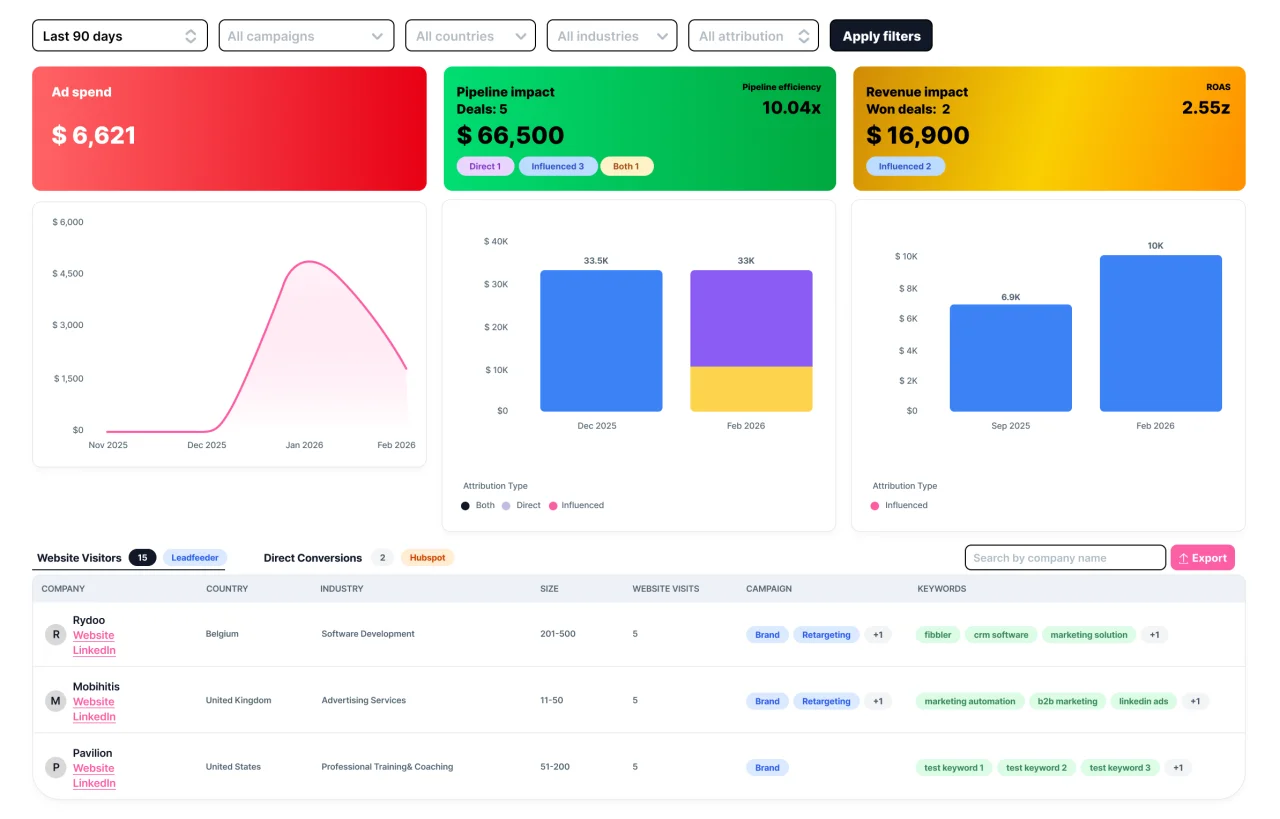
It ensures your attribution reflects financial reality by:
- Revealing the company identity behind anonymous ad clicks.
- Verifying if your campaigns reach your target market before a form fill.
- Syncing clean ad data with your CRM to connect offline revenue.
- Blocking invalid traffic from bots and competitors in real-time.
2. Switch to Data-Driven Attribution
You should move away from static models like Last Click to unlock the full potential of Smart Bidding. Smart Bidding refers to automated strategies that use machine learning to optimize your bids for every single auction based on the likelihood of a sale.
By switching to Data-Driven Attribution you feed this system the full context it needs to dynamically value assist keywords in real time. This allows you to scale strategies like Target ROAS with confidence knowing that the algorithm is optimizing for the entire journey rather than just the final capture point.
3. Implement Enhanced Conversions
Privacy regulations and browser restrictions make it harder to track users using cookies alone. Enhanced conversions solve this by allowing you to send hashed first-party data like email addresses back to Google in a privacy safe way.
This helps the system match users who viewed an ad on one device but converted on another. It recovers data gaps and gives your attribution model a more complete view of the cross-device journey.
4. Connect Offline Conversions
To close the loop between digital leads and signed contracts you must implement Offline Conversion Tracking (OCT). This mechanism lets you upload sales data from your CRM back into Google Ads so the system can see what happened after the initial click. By importing this value based conversion data you train the attribution model to recognize deal quality.
This forces the bidding algorithm to prioritize expensive keywords that generate revenue over cheap keywords that only generate volume.
Build a Revenue-Focused Attribution Engine
Selecting the right attribution model is only the foundation. The real competitive advantage in 2026 lies in the integrity of the data feeding that model. Since Google AI optimizes based on received signals, protecting your account from spam is the only way to ensure your budget targets actual revenue.
Fibbler secures this process for you by filtering out invalid traffic that falsifies Data Driven models. By revealing the company identity behind every click and syncing it to your CRM it forces your strategy to align with financial reality instead of misleading signals.
Get started with Fibbler for free.
Written by

Adam Holmgren
CEO @ Fibbler

See the real impact of your Paid Ads
Fibbler connects your ads data to your CRM so you can see which companies your ads influence and give your execs proof that LinkedIn & Google drives revenue.
Try 30 days for free
See the real impact of your Paid Ads
Fibbler connects your ads data to your CRM so you can see which companies your ads influence and give your execs proof that LinkedIn & Google drives revenue.
Try 30 days for free